Support

Setting up ActiveCampaign to capture UTM parameters and Marketing Attribution

Step-by-step setup to add Madlitics fields to ActiveCampaign so every response includes channel, campaign, and landing page attribution.
Attribution is broken

ActiveCampaign is a popular platform for email marketing, automation, and CRM. Its built-in form builder allows you to quickly create lead capture forms and embed them on your website.

When you pair ActiveCampaign forms with Madlitics, every submission is automatically enriched with attribution data — including the marketing channel, campaign details, and landing page that brought the lead to your site. This allows your marketing and sales teams to see exactly where leads originate, directly inside your ActiveCampaign records.

In this guide, we’ll walk through creating a new ActiveCampaign form, adding Madlitics fields, and embedding the form so you can begin capturing clean, first-party attribution data.

Heads-up: Madlitics must be installed on the domain where the ActiveCampaign form is published. The form itself does not collect attribution data — Madlitics passes that information into the form.

1. Create attribution fields in ActiveCampaign

Before building your form, you’ll first need to create the Madlitics attribution fields inside ActiveCampaign. These fields store the marketing data Madlitics passes into each submission — including the marketing channel, campaign segments, and landing page information.

In your ActiveCampaign dashboard, open the Contacts section and navigate to Fields. This is the field manager where you can create and customize fields used across your contacts and forms.

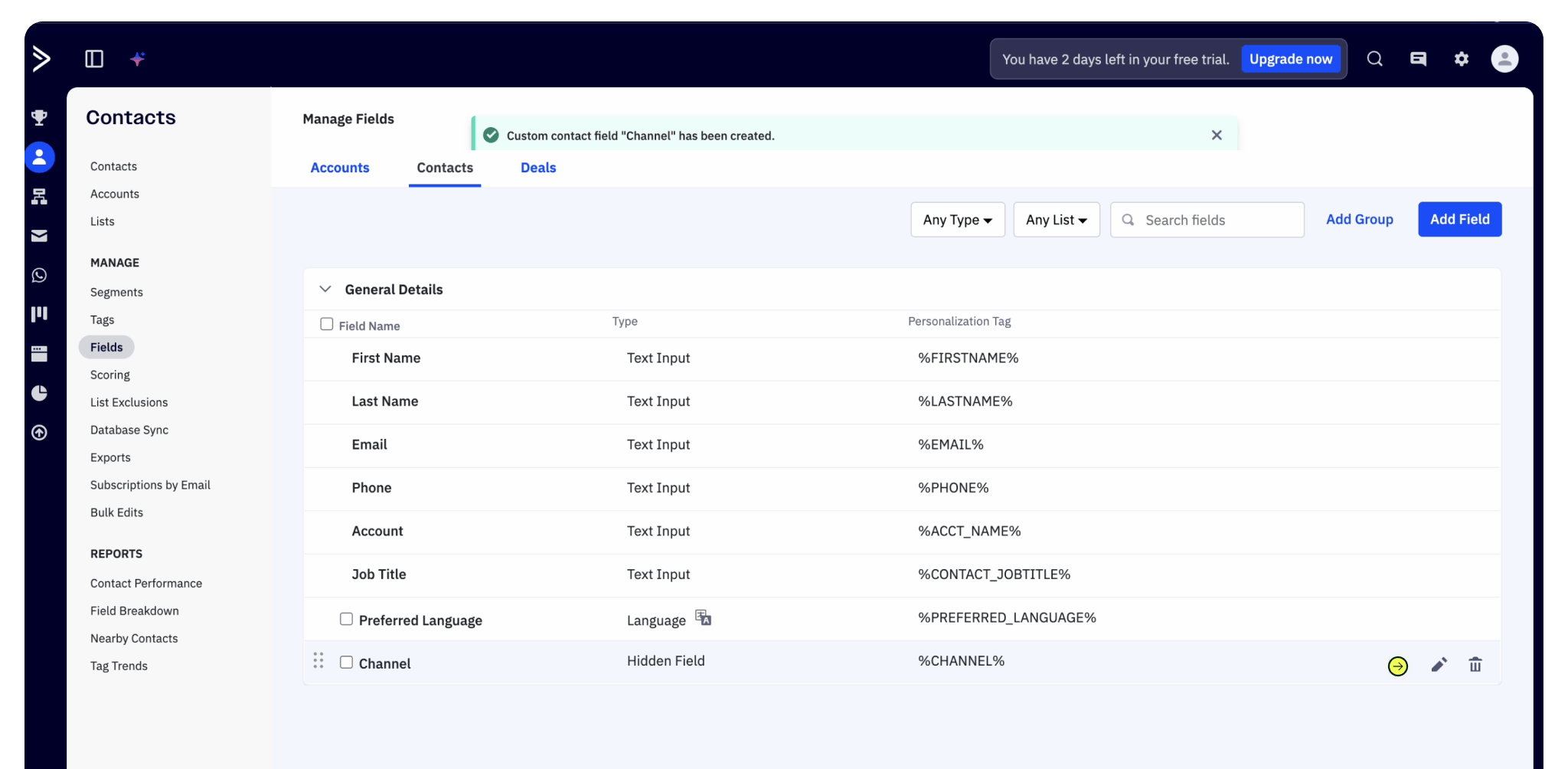
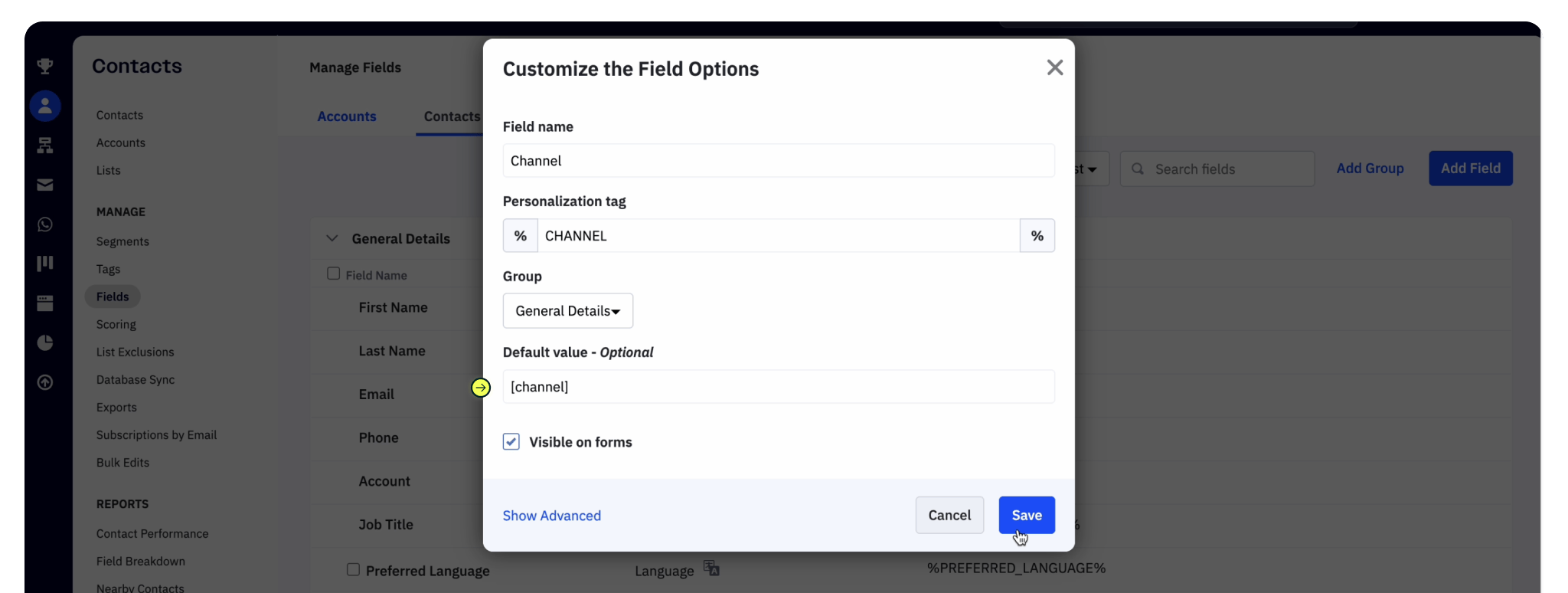
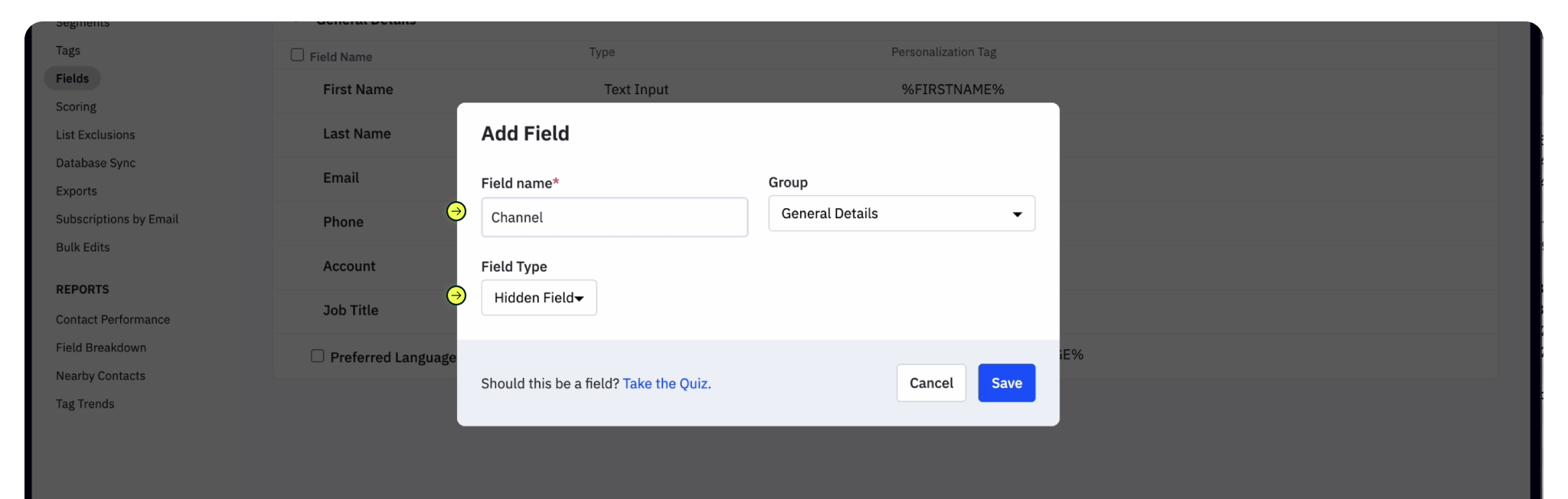
Click Add Field to create a new field. Enter the Field Name based on the Madlitics attribution fields listed below, and set the Field Type to Hidden Field. Once the field is created, click on the edit icon to open the field customization settings. Here you’ll update the Default Value so it matches the Madlitics field value. This allows Madlitics to automatically populate the field when a form is submitted.

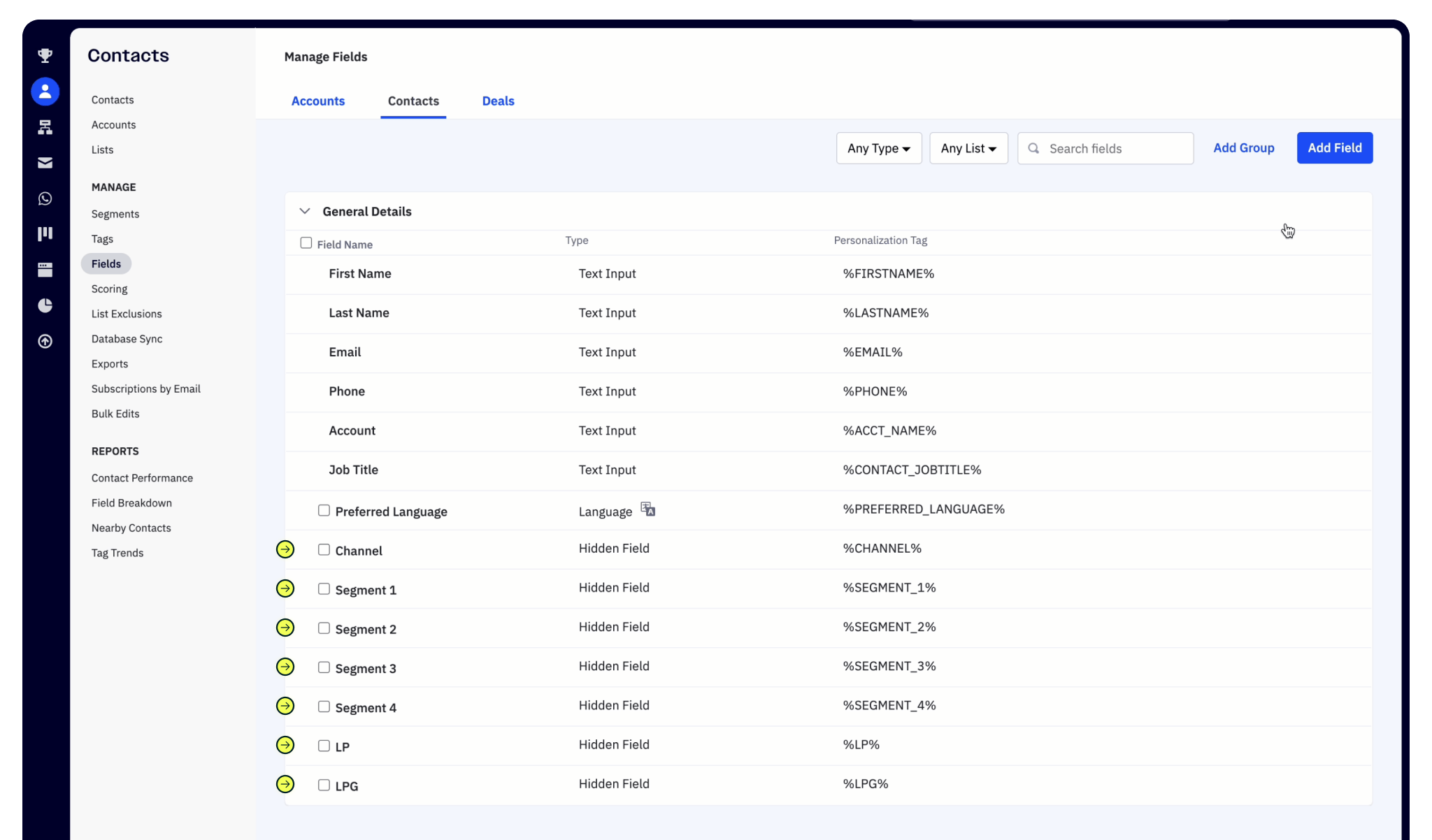
Repeat this process for each of the Madlitics attribution fields so your ActiveCampaign account is ready to capture attribution data with every new contact submission.
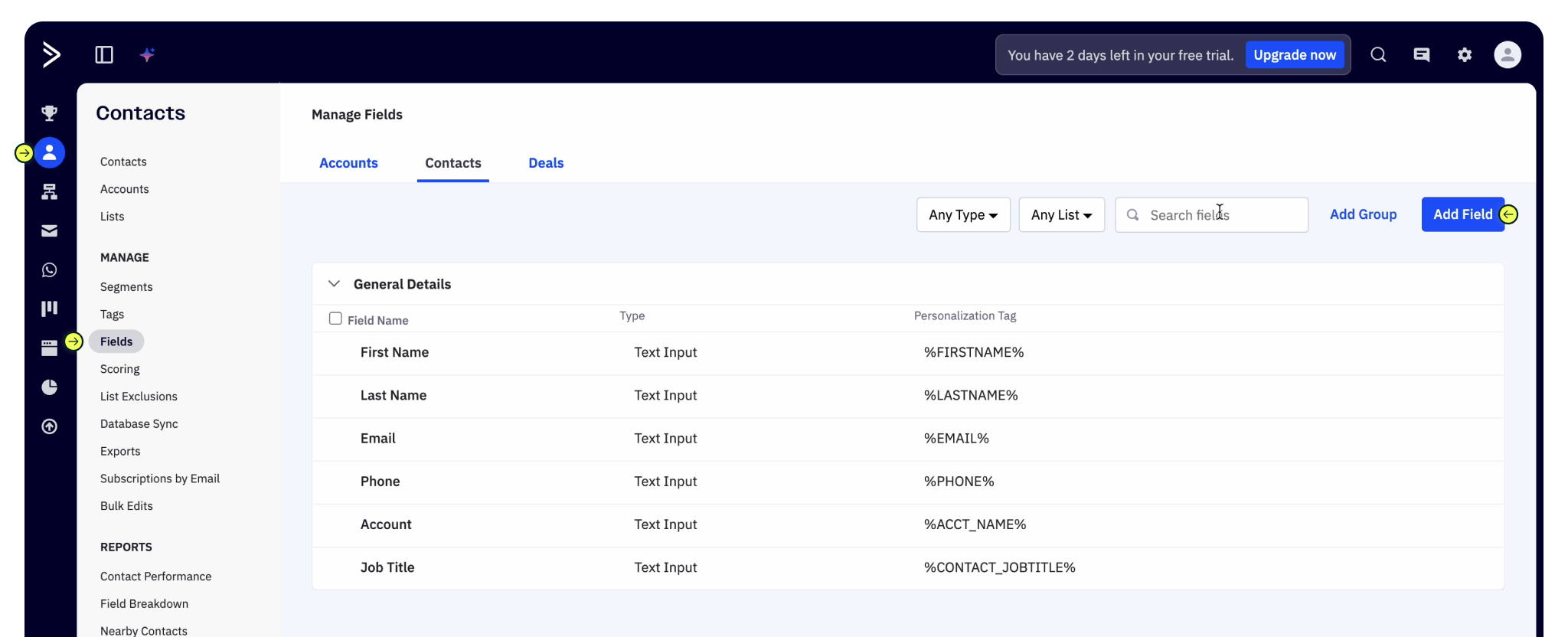
In your ActiveCampaign dashboard, open the Contacts section and navigate to Fields.

Click Add Field to create a new field. Enter the field name based on the Madlitics attribution fields listed below, and set the Field Type to Hidden Field.

Once the field is created, click on the edit icon to open the field customization settings.

Here you’ll update the Default Value so it matches the Madlitics field value.

Repeat this process for each of the Madlitics attribution fields so your ActiveCampaign account is ready to capture attribution data

Madlitics Attribution Fields and Values

Madlitics uses a set of hidden attribution fields to capture the marketing context behind every form submission. These fields are automatically populated when a visitor submits a form on a page where Madlitics is installed. Instead of relying on fragmented analytics reports, the attribution data travels with the lead itself — allowing your CRM to store the marketing channel, campaign details, and landing page associated with each contact.

The seven Madlitics fields below work together to describe how a visitor arrived at your site. Some fields capture high-level channel information, while others record campaign-level details like UTMs, keywords, or creative variations. Additional fields record the landing page where the visitor first entered your site, helping you understand which pages and campaigns generate the most leads. Configure additional Madlitics field value pairs for deeper customization and richer insights.

Once these fields are configured in ActiveCampaign, Madlitics automatically passes attribution values into them when a form is submitted. This ensures every contact record contains consistent, structured marketing data that can be used for reporting, segmentation, and automation.

Marketing Channel
Categorizes the visit’s marketing channel based on multiple signals, including traffic type, referring domain, and known platforms.
Field name: Channel
Type: Hidden Field
Default value: [channel]  

Segment 1
Captures the source of the traffic, identifying the specific platform, publisher, or partner that sent the visitor to your site; for paid traffic, this field records the utm_source, for organic traffic the platform, for referrals the referring domain, and for direct traffic no value is captured.
Field name: Segment1
Type: Hidden Field
Default value: [segment1]

Segment 2
Captures the campaign-level details associated with the visit, identifying which campaign, promotion, or initiative led the visitor to your site; for paid traffic, this field records the utm_campaign, for organic traffic the referring domain, and for direct traffic no value is captured.
Field name: Segment2
Default value: [segment2]

Segment 3

Captures the keyword, creative variation, or content-level detail that influenced the visit, such as a paid search term, specific ad, post type, or format; for paid traffic, this field records the utm_term, for organic traffic the full referring URL when available, and for direct traffic no value is captured.
Field name: Segment3
Type: Hidden Field
Default value: [segment3]

Segment 4
Captures the audience, ad group, or offer associated with the visit, showing how the traffic was segmented within a campaign; for paid traffic, this field records the utm_content, and for organic and direct traffic no value is captured.
Field name: Segment4
Type: Hidden Field
Default value: [segment4]

Landing Page
Captures the exact page where the visitor first entered your site, recording the original entry point of the session.
Field name: lp
Type: Hidden Field
Default value: [lp]

Landing Page Group
Captures the category or logical grouping of the landing page, allowing multiple related entry points to be analyzed under a shared identifier.
Field name: lpg
Type: Hidden Field
Default value: [lpg]

2. Create an ActiveCampaign form to capture  attribution

Now that the Madlitics attribution fields exist in your ActiveCampaign account, the next step is creating a form that includes those fields.

From the ActiveCampaign dashboard, navigate to Website → Forms. Here you’ll see a list of any forms already in your account along with the option to create a new one.

Create a new form (using AI or start from scrtach) or choose an existing form previously created. For new forms ActiveCampaign will prompt you to configure a few settings such as the title, and form actions.

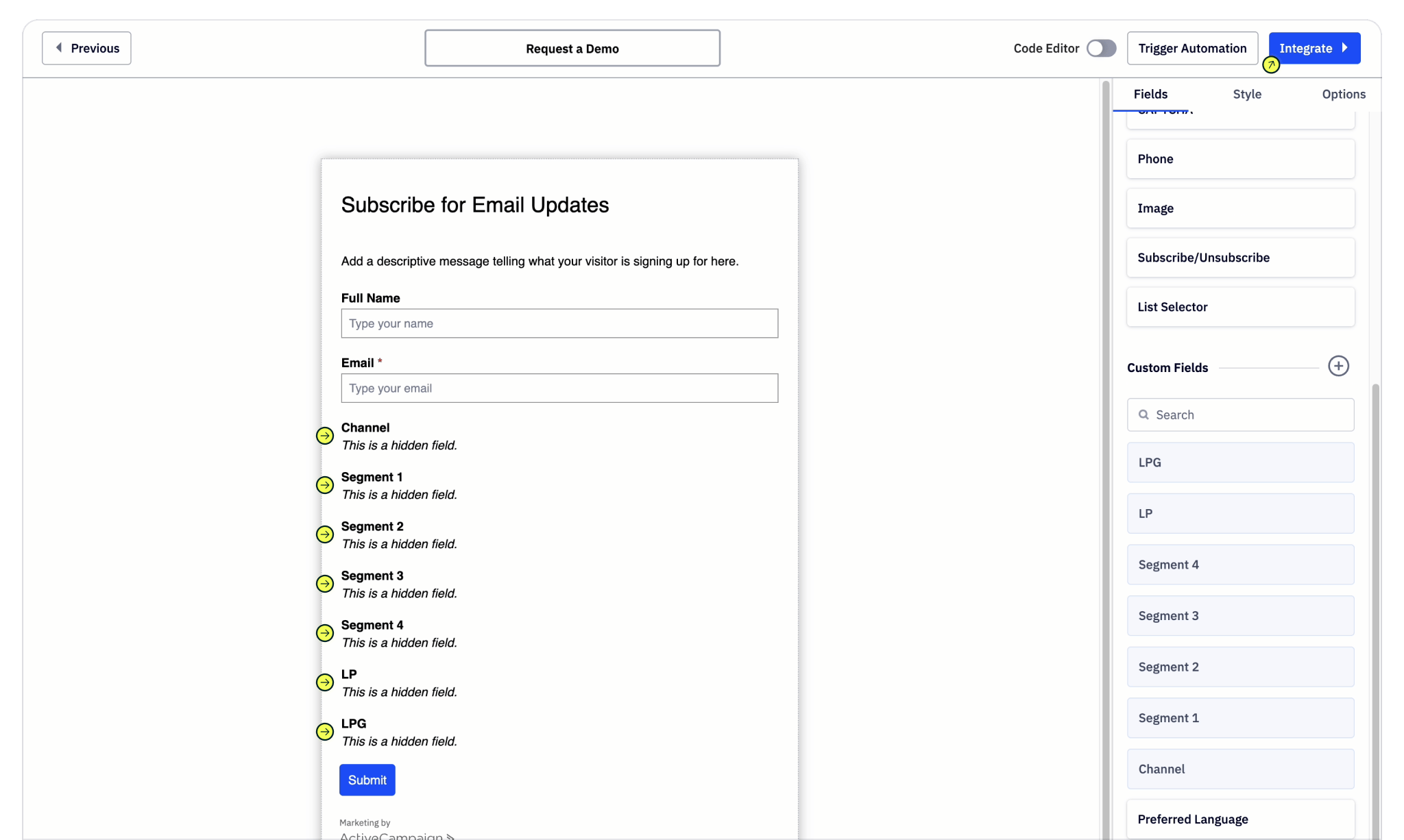
Once the form is created, the form builder will open. This is where you’ll add the fields that should appear on your form, such as name and email, along with the Madlitics attribution fields you created in the previous step.

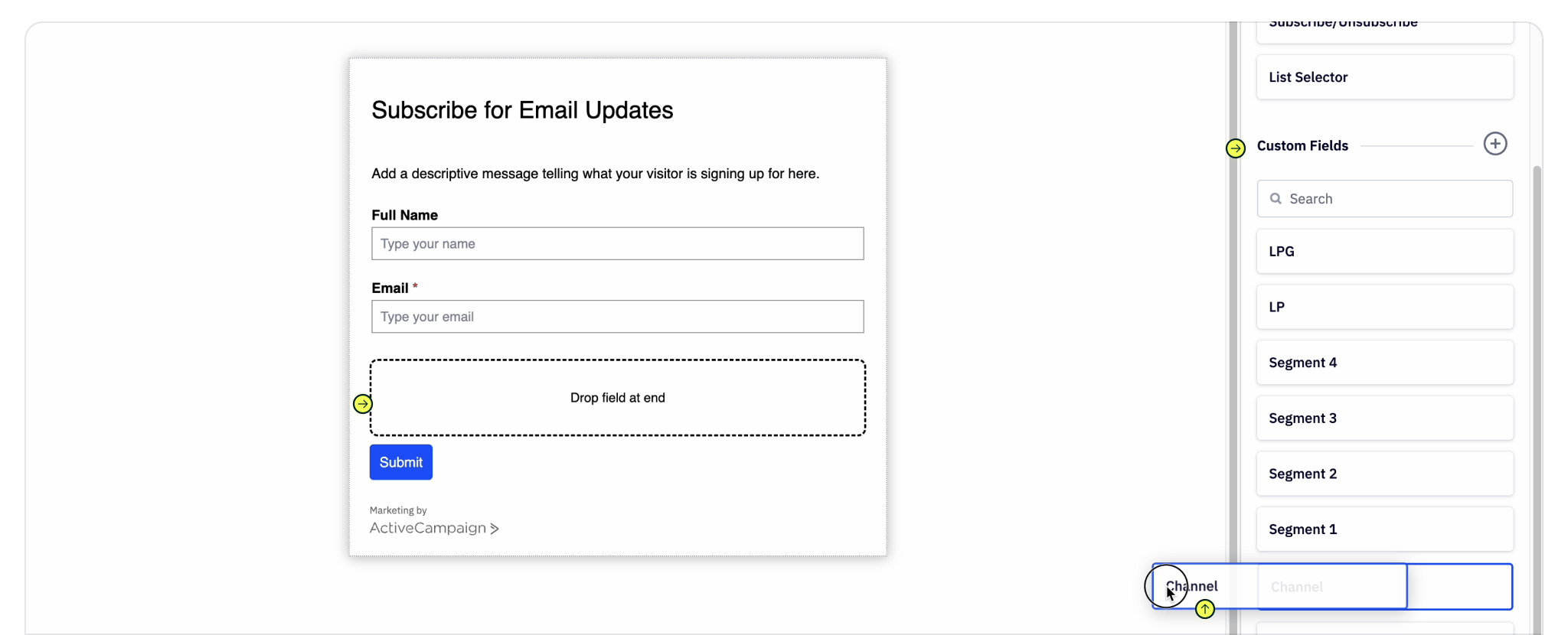
On the right side of the builder, scroll down to the Custom Fields section. You’ll see the attribution fields you created earlier — including Channel, Segment 1–4, LP, and LPG. Drag each of the attribution fields created earlier, into your form. Since the fields have been configured as hidden fields, they won’t be visible to visitors filling out the form, but they will still receive the attribution data passed in by Madlitics.

Once all seven attribution fields are added, your form is ready to capture enriched submission data. Click the Integrate button for embed options. Every time someone completes the form, ActiveCampaign will store the attribution context alongside the contact record — making it easy to see which channels, campaigns, and landing pages generate your leads.
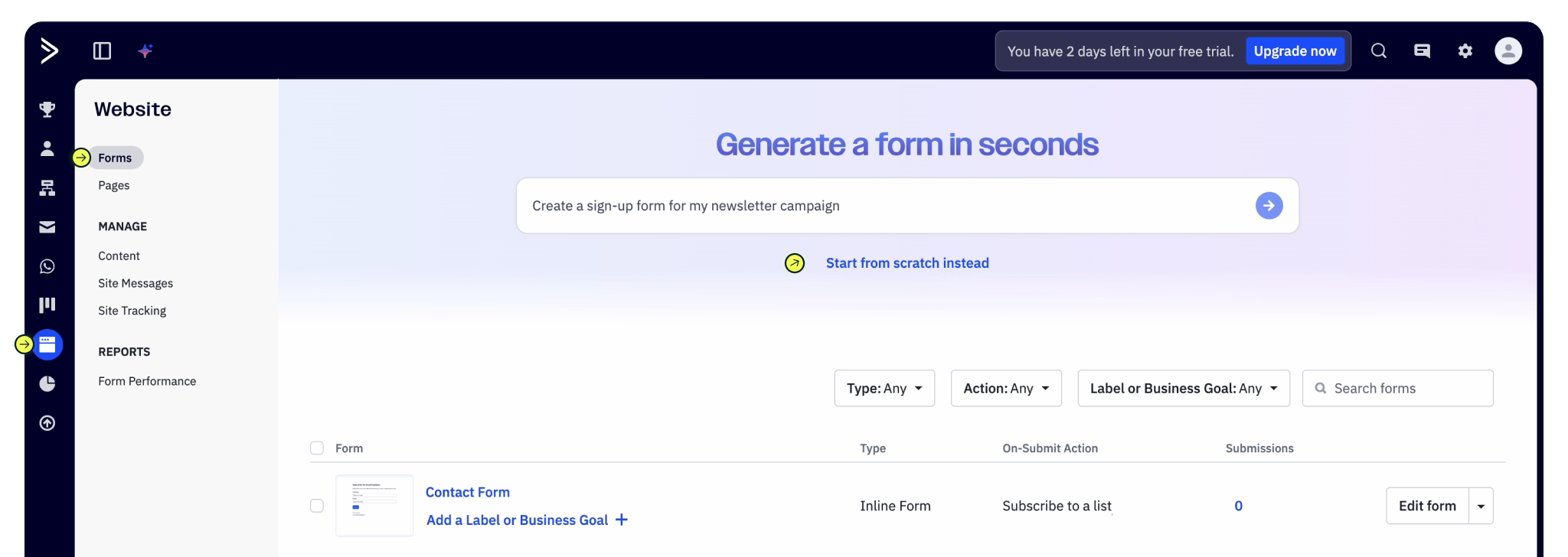
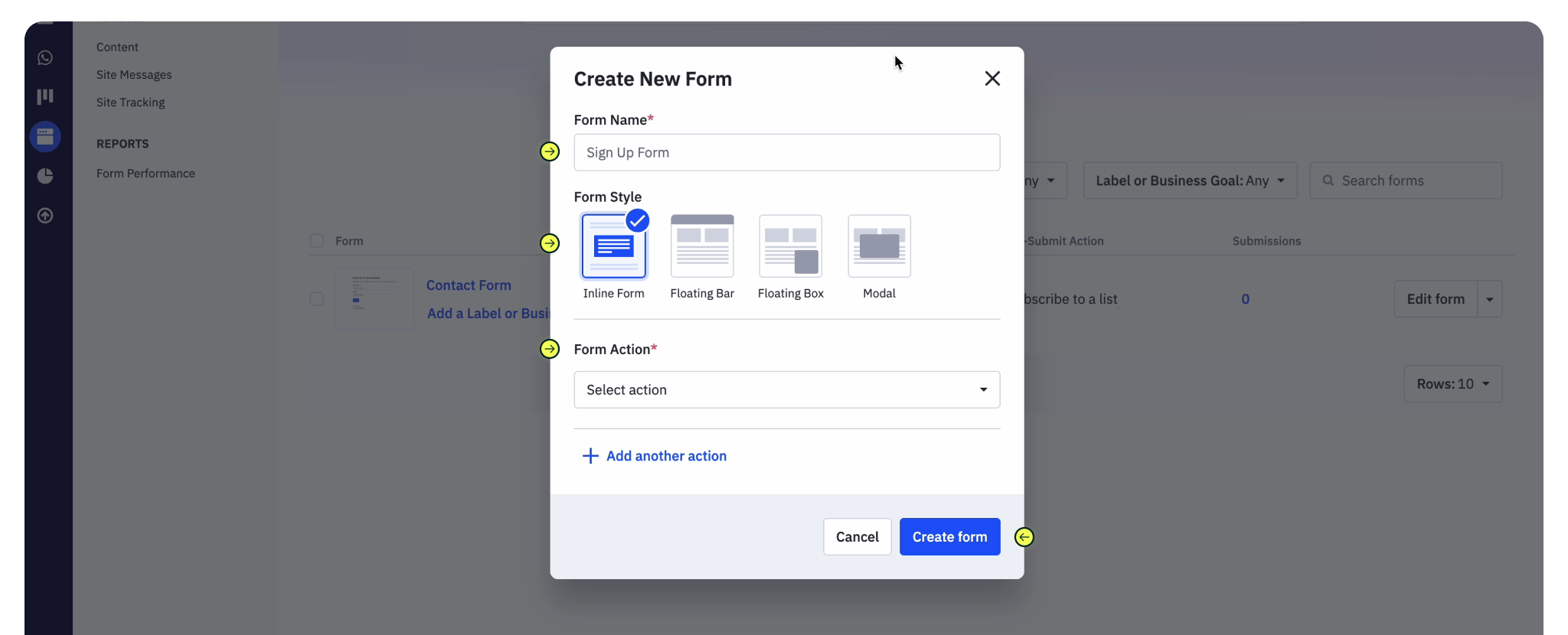
Create a new form or choose an existing one.

Configure the form settings

Drag the custom attribution fields into your form

Once your form as all the attribution fields click Integrate in the top-right corner to proceed to the embed options.

3. Integrate and embed your ActiveCampaign form

With your form configured and the Madlitics attribution fields added, the next step is placing the form on your website so visitors can submit it. Click Integrate in the top-right corner, opening the publishing options where you can choose how the form will appear on your site.

Copy the embed code and paste it into the page where you want the form to appear — such as a landing page, contact page, or signup section.

Once the page is published, visitors will be able to submit the form and the Madlitics fields will automatically receive attribution data. As long as Madlitics is installed on the domain where the form is embedded, each submission will include the full marketing context behind the visit.
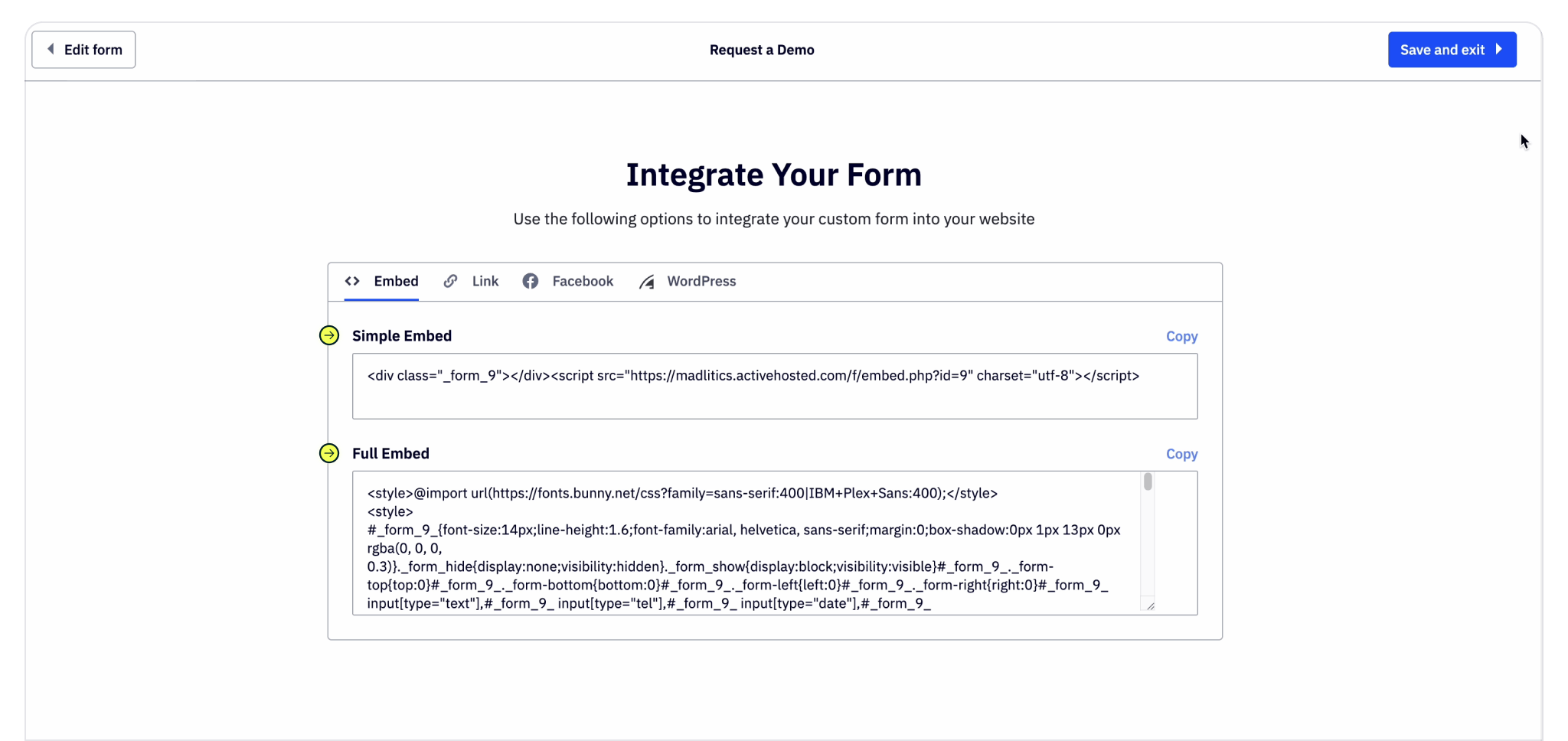
Choose your integration method and copy the embed code

4. Test your form and verify attribution data

Once your form is embedded, ActiveCampaign will create a contact record for each submission and capture basic contact details. Madlitics will automatically fill in the attribution fields — including channel, campaign segments, and landing page — right alongside that contact information.

To test the setup, visit your site using a URL with UTM parameters (for example, add utm_source, utm_medium, or utm_campaign to the link) then check the contact record in ActiveCampaign — you should see Madlitics attribution data populated, confirming a successful setup. You can quickly generate these test links using the Madlitics UTM Builder.
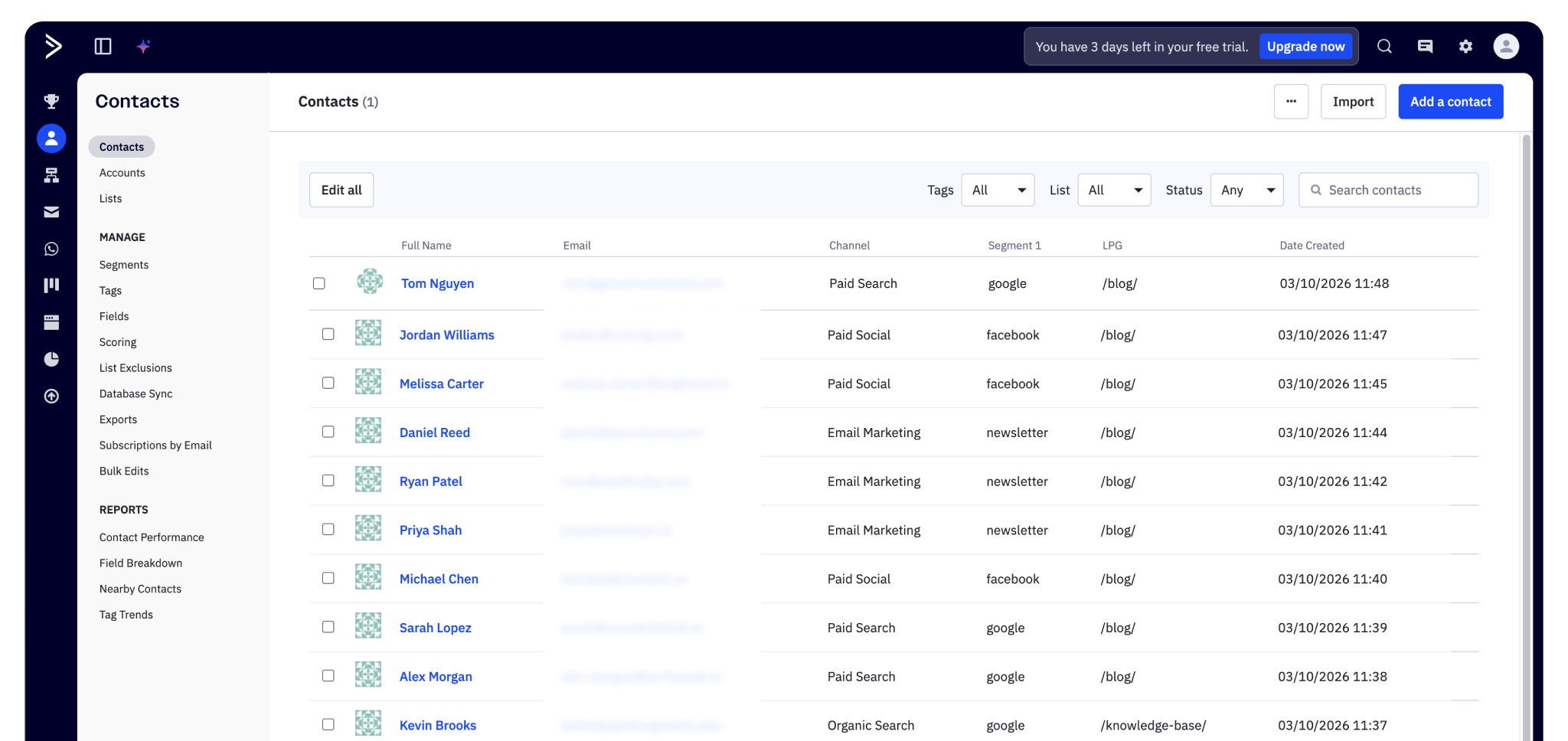
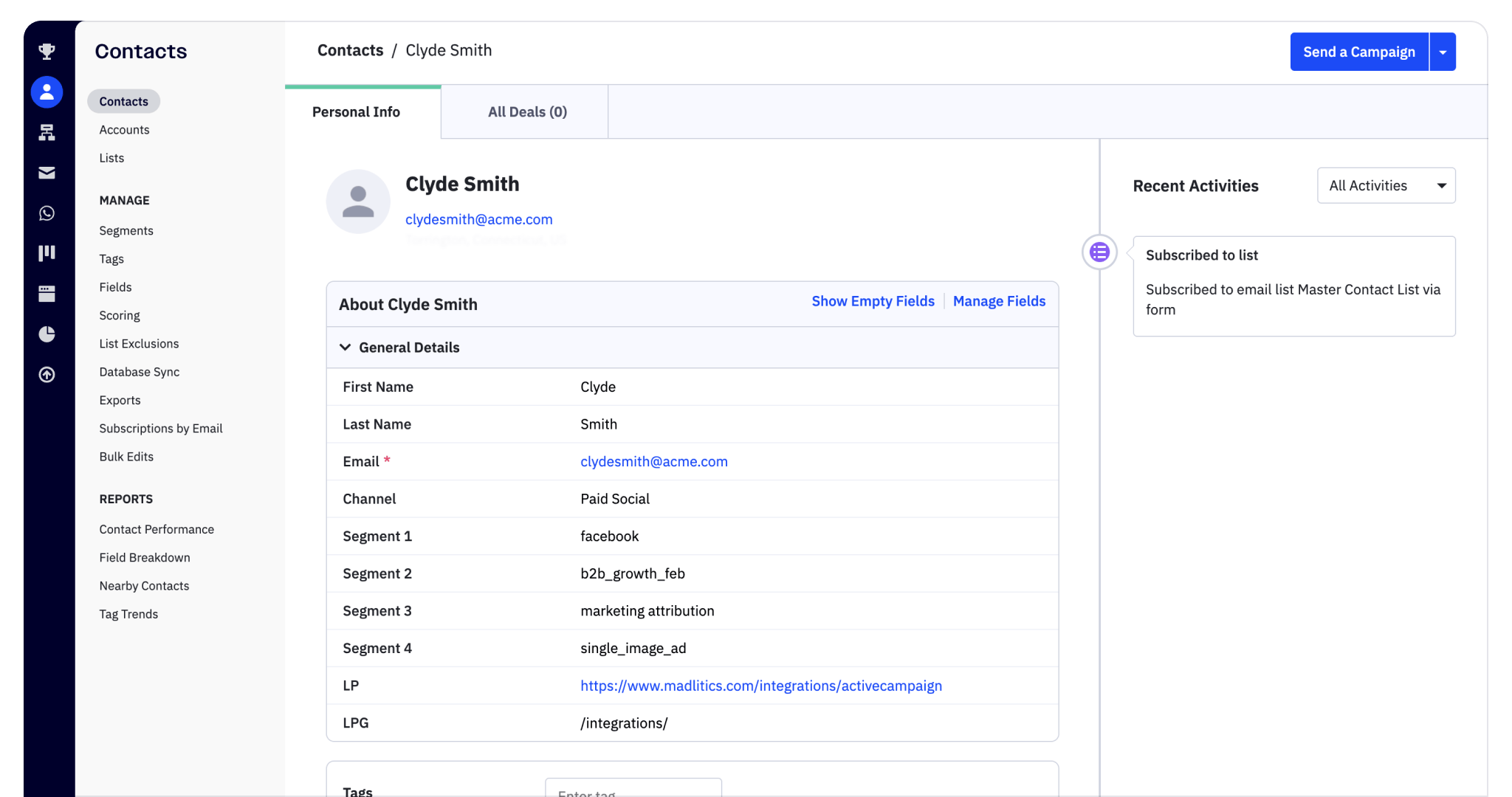
Form submissions now include marketing attribution data
View attribution data inside the contact record
Madlitics multi-channel attribution visualization, showing marketing platforms like TikTok, Instagram, Google, and Facebook. The graphic highlights how different sources contribute to high-performing marketing channels.
1. Add UTM parameters to all inbound links
Any marketing effort that drives traffic — whether it’s a paid ad, an email campaign, or an organic post — should have properly structured URLs that clearly define the visitor’s origin. Setting it up is a straightforward process that starts with ensuring all inbound links include UTM parameters.

A LinkedIn campaign, for example, might link to:
https://yoursite.com/?utm_source=linkedin&utm_medium=paidsocial&utm_campaign=q1_promo
Screenshot of a form builder interface with a highlighted 'Hidden Input' field. Accompanied by text explaining how to install and set up Madlitics by adding hidden fields to capture marketing attribution data.
2. Add hidden fields
Once you’ve added UTM tracking to your inbound links, the next step is to install Madlitics on your site and update your Framer Forms to include hidden fields that will store attribution data when a visitor submits a form automatically. Hidden fields to include:
• Channel (e.g., Paid Search, Organic Social, Direct)
• Segment 1 (Platform name: Google, LinkedIn, Twitter)
• Segment 2 (Campaign name)
• Segment 3 (Ad group, offer name, or post type)
• Segment 4 (Creative type or ad variation)
• Landing page/group (Tracking & first-touch attribution)
CRM interface showing a detailed view of captured attribution data, including marketing channels, segments, and landing pages. A business profile of a lead is displayed, highlighting how Madlitics enriches lead data for sales and marketing teams.
3. Utilize attribution data
With the setup complete, every form submission in Framer now carries full attribution data, ensuring accurate insights into where leads originate. Pass this data to your CRM, analytics tools, or marketing automation platforms to track performance, refine campaigns, and optimize marketing efforts with precision.

With Madlitics now active in your ActiveCampaign forms, every new lead will automatically include full marketing attribution data — giving your team instant visibility into which channels and campaigns drive conversions, right inside your CRM. From here, you can use these insights to segment leads, personalize automations, and report on true campaign performance.

Related articles to get you started with Madlitics

Frequently asked questions

Answers to your top questions about our UTM parameters
Put attribution data to work
Sync, analyze, and automate — turn insights into action.
Automation icon indicating hands-free marketing attribution and data flow.
Sync with your CRM
Pass UTM parameters into Salesforce, HubSpot, or ActiveCampaign so your sales team knows exactly where every lead came from — no more guessing.
Analytics report icon, indicating data insights and reporting.
Built smarter reports
Use Google Sheets, Looker Studio, or Airtable to create data-driven reports that reveal which campaigns drive real revenue — helping you make informed budget decisions.
Impact measurement icon, symbolizing marketing effectiveness.
Track revenue impact
Sync UTM data with Stripe, PayPal, or Chargebee to see which campaigns generate paying customers, not just leads — so you can scale what works.
Personalization icon, representing customization features.
Personalize email campaigns
Trigger personalized email flows in Klaviyo, Mailchimp, or ConvertKit based on a lead’s original source — ensuring the right message reaches the right audience.
Visualizing your marketing impact
See how attribution data translates into actionable insights.
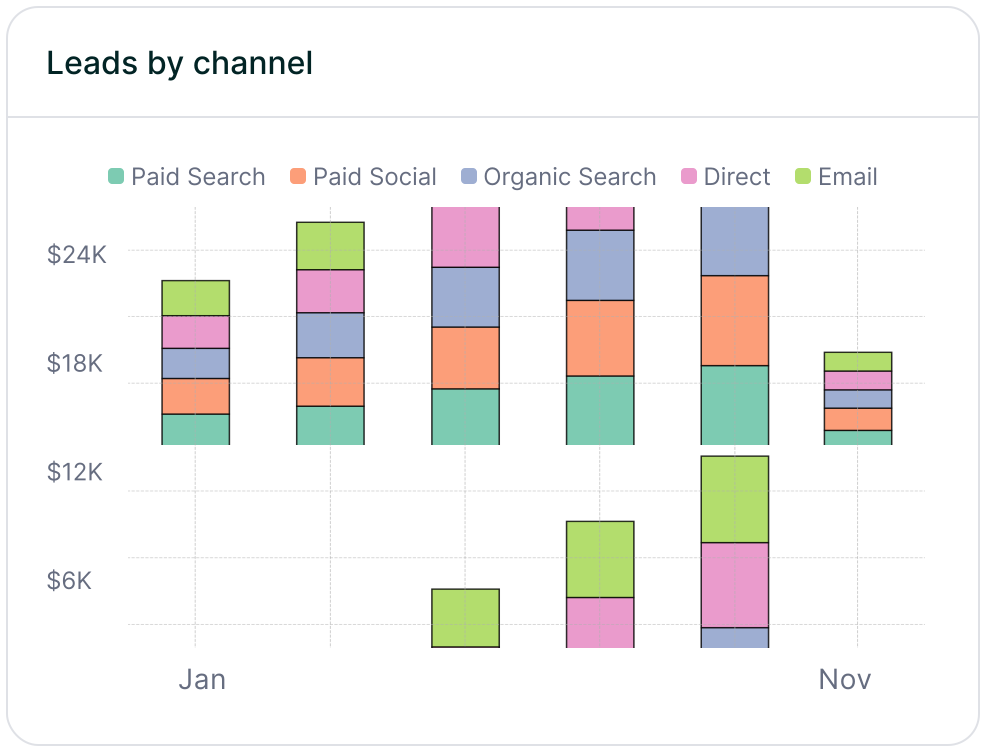
Stacked bar chart showing lead generation by marketing channel over time, comparing sources like Paid Search, Paid Social, Organic Search, Direct, and Email. Helps visualize which channels drive the most traffic.
Leads by channel
See how different marketing channels contribute to lead generation over time. Understand which ones drive the most traffic and whether your marketing mix is balanced. Shift your budget toward the highest-performing channels to maximize results.
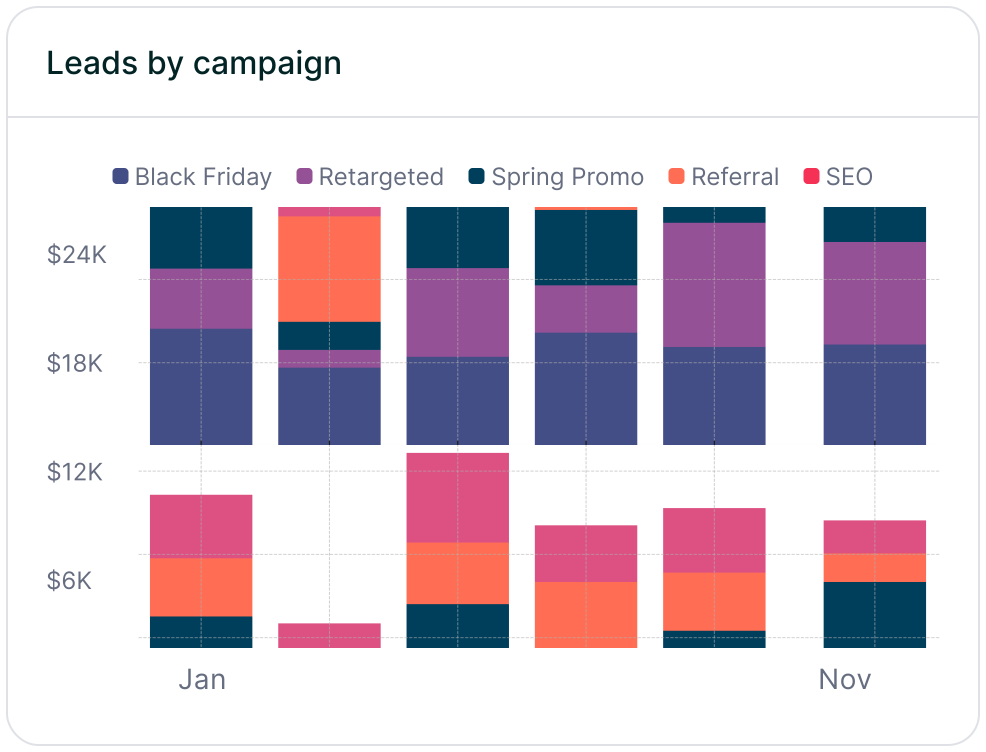
Stacked bar chart illustrating lead volume across different marketing campaigns, including Black Friday, Retargeted, Spring Promo, Referral, and SEO. Highlights trends in campaign effectiveness.
Leads by campaign
Track inbound leads across all campaigns, whether or not they have UTM parameters. Ensure every lead is categorized correctly, including Organic and Referral traffic. Use this insight to refine messaging, targeting, and budget allocation for better performance.
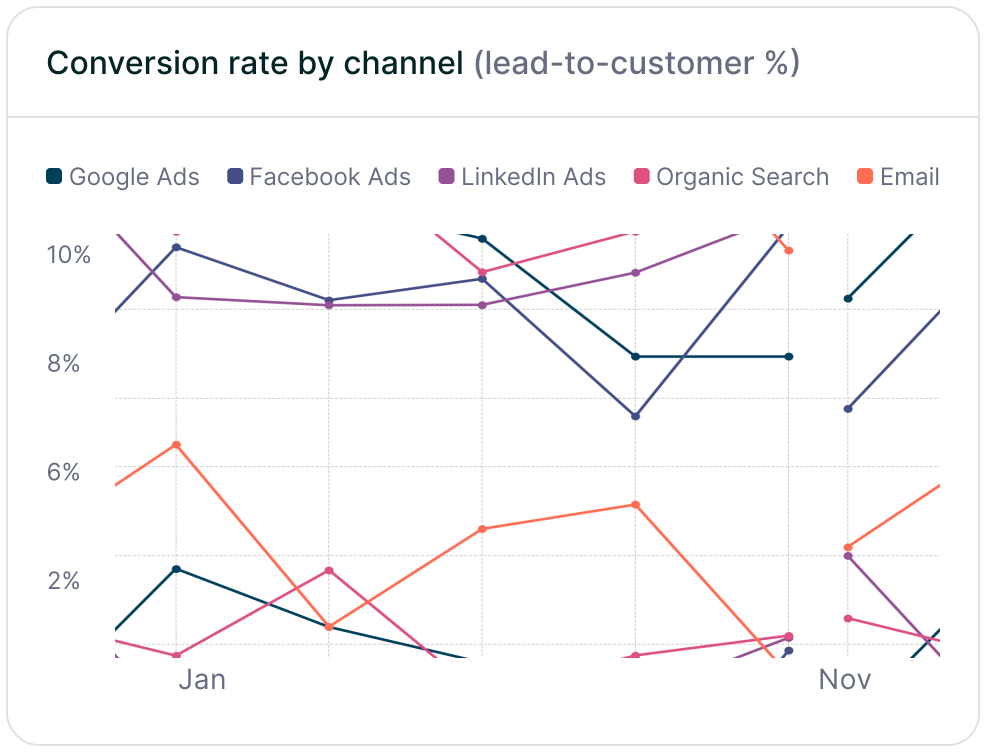
Line chart displaying lead-to-customer conversion rates by channel, comparing Google Ads, Facebook Ads, LinkedIn Ads, Organic Search, and Email. Shows how different sources drive qualified leads over time.
Conversion rate by channel
See which channels convert leads into paying customers. Some bring buyers, while others generate unqualified leads. Focus your budget on what drives revenue.
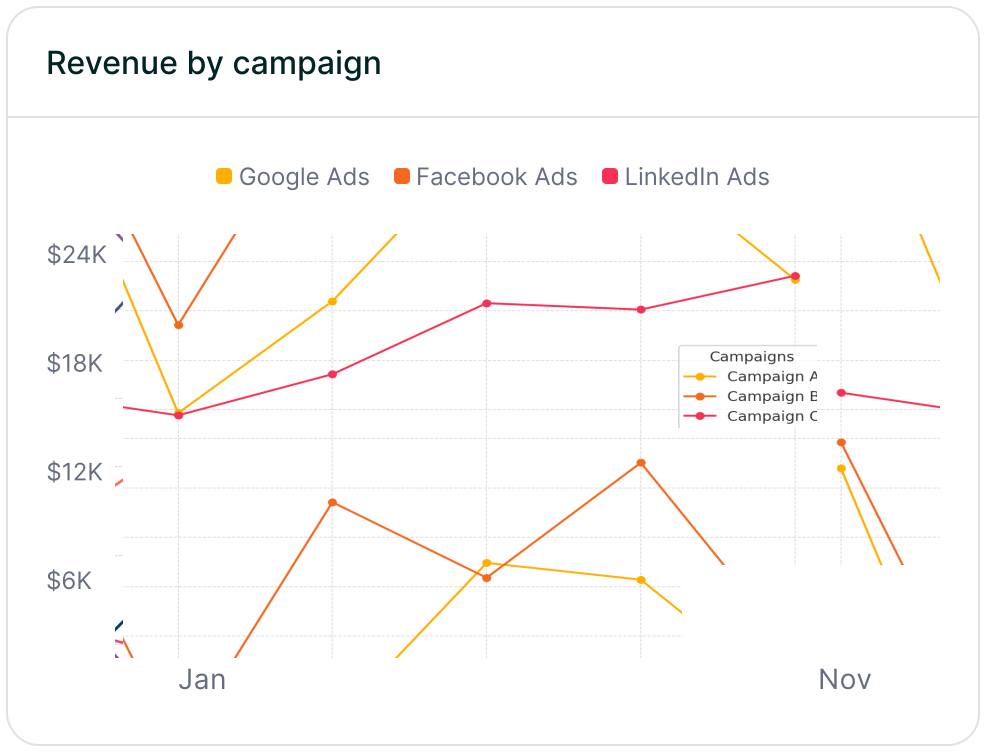
Line chart showing revenue performance by marketing campaign, comparing Google Ads, Facebook Ads, and LinkedIn Ads. Helps identify top-performing and underperforming campaigns.
Revenue by campaign
Focus your budget on campaigns that drive revenue, not just leads. Identify top performers and optimize underperforming efforts to maximize profitability.
Everything you need for reliable lead attribution
Accurate, persistent, and automated tracking — so your campaigns perform at their best.
Performance icon symbolizing marketing campaign effectiveness and results tracking.
Outperforms basic UTM tracking
Madlitics captures, categorizes, and persists attribution data across sessions, giving you a complete, structured view of what’s working in your marketing. Say goodbye to losing attribution when users navigate your site, struggling with formatting inconsistencies, and ingored non-UTM traffic.
Capture icon indicating data collection from various marketing channels and sources.
Capture all traffic
Madlitics categorizes all inbound leads — whether they have UTM parameters or not — so every conversion is accounted for, and you won't miss out on Organic Search, Organic Social, and Referral traffic.
Routing icon representing the flow of marketing data and attribution pathways.
Attribution across pages and sessions
A LinkedIn ad click should be attributed correctly—even if the visitor signs up on a different page later. If someone clicks an ad, browses multiple pages, then submits a form later, Madlitics persists attribution data across sessions, ensuring your reports reflect true performance.
List icon representing structured marketing data, reports, or campaign breakdowns.
Cleaner, more reliable data
Duplicate UTMs and inconsistent formatting break reports and mislead teams. Madlitics cleans and organizes attribution data before sending it to your CRM, giving you accurate insights.
Target icon symbolizing precise audience targeting and marketing campaign focus
See which content converts
Attribution isn’t just about where visitors came from—it’s about what convinced them to convert. By capturing landing page data alongside UTM parameters, Madlitics shows you which blog posts, case studies, or pricing pages drive the most revenue, helping you scale content that works.
Action icon representing campaign execution, optimization, and engagement.
Transform form submissions into actionable insights
Madlitics connects marketing touchpoints to lead generation, ensuring every form submission is fully attributed — optimize ad spend by identifying high-ROI channels, refine messaging based on what content drives engagement, make data-driven decisions with clean, structured reports, and more.