Your Attribution Model Is Only As Good As the Data Behind It
Broken UTMs, duplicate conversions, and inconsistent naming don't just create messy reports — they quietly drain your budget and misdirect your strategy. These best practices show you how to validate, clean, and maintain attribution data you can actually trust.
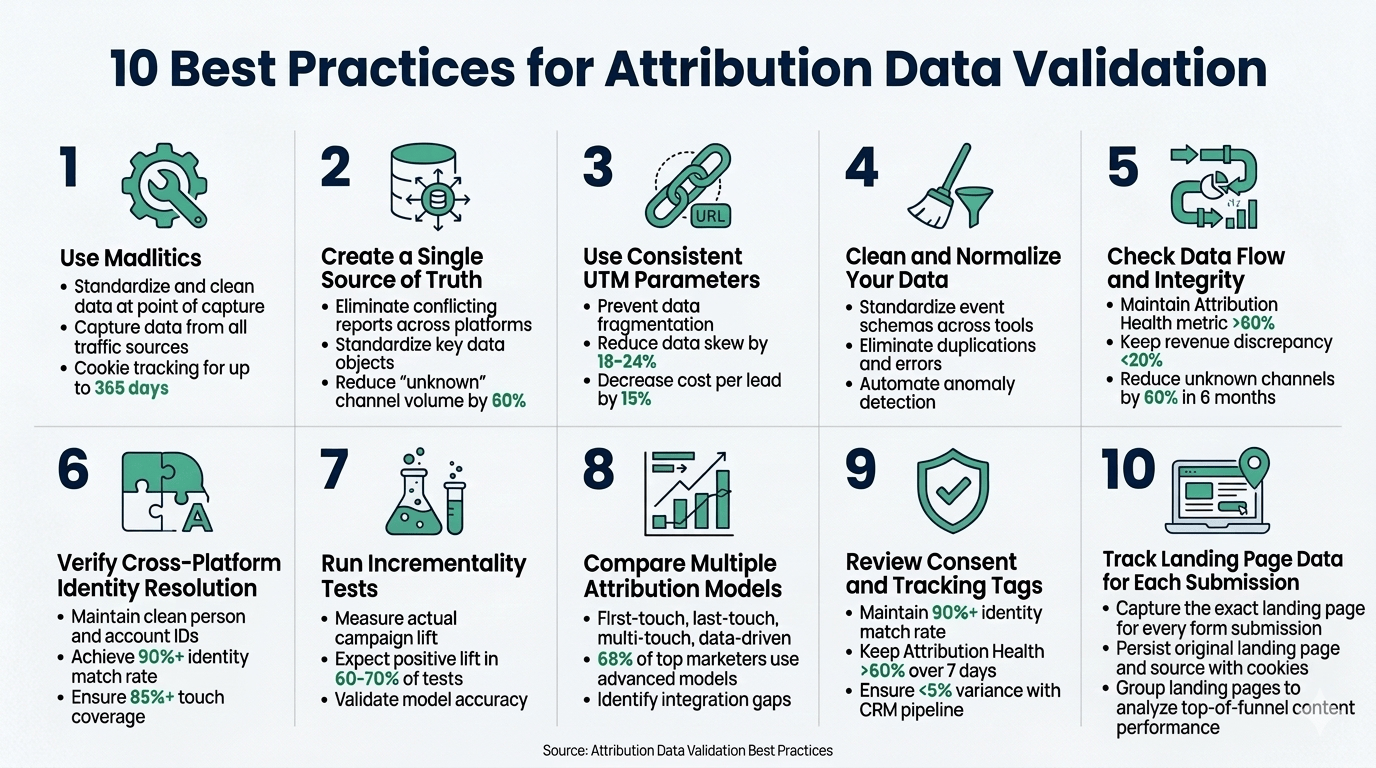
Attribution data validation is the key to making informed marketing decisions. Without accurate data, you're guessing - not strategizing. Missteps in tracking can lead to wasted budgets and missed opportunities. Here's a quick rundown of how to ensure your data is reliable and actionable:
Use tools like Madlitics to standardize and clean data at the point of capture.
Create a single source of truth to eliminate conflicting reports across platforms.
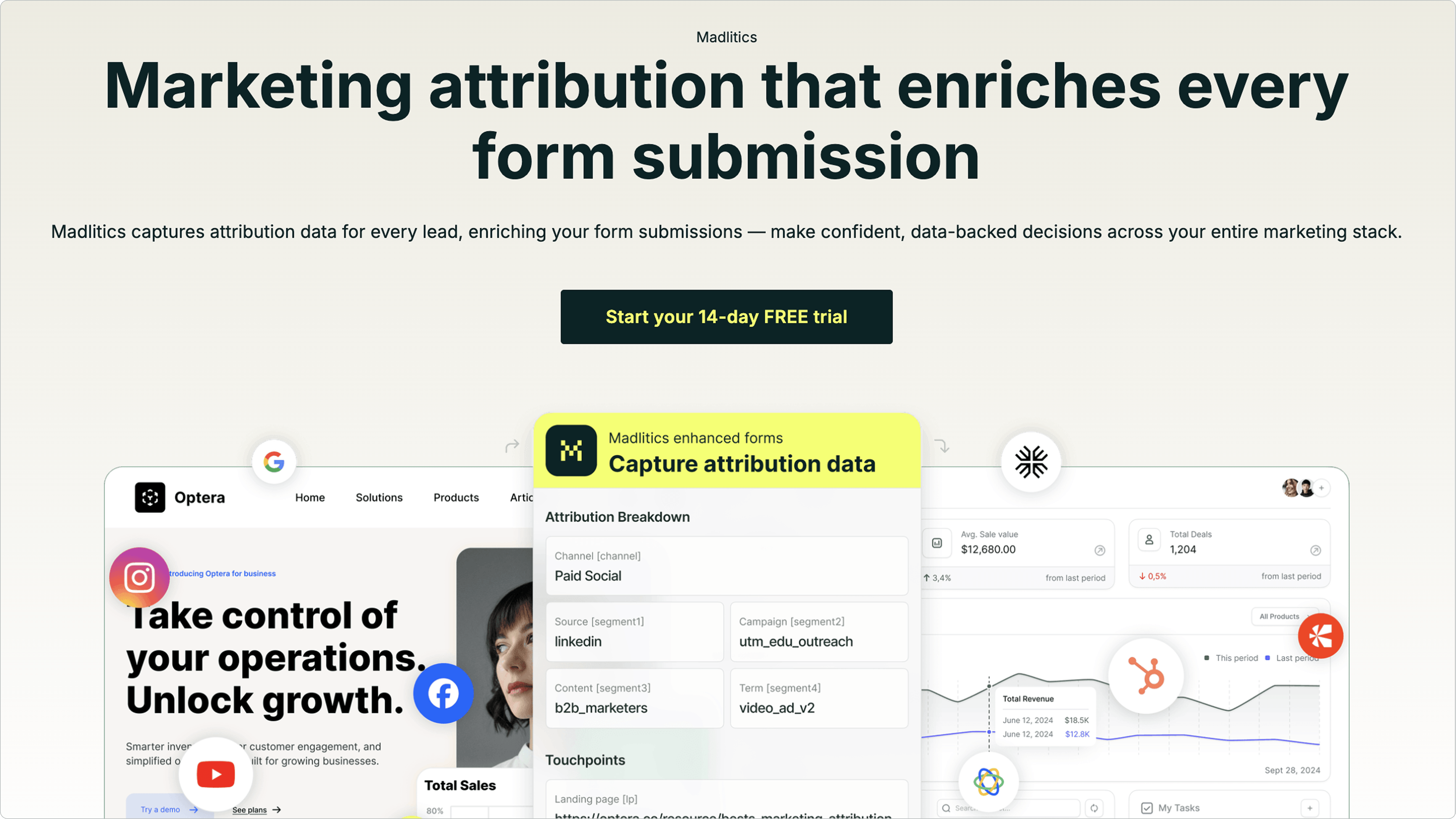
Accurate attribution data starts with a dependable system for capturing information. This is the foundation for gaining actionable insights throughout your marketing funnel. Madlitics ensures every form submission includes full marketing context, giving your CRM clean, structured, and reliable data to work with.
Data Accuracy and Reliability
Many attribution issues arise before the data even reaches your reporting tools. Madlitics tackles this by automatically organizing and standardizing marketing data at the point of capture, as detailed in our marketing attribution guides. It resolves formatting inconsistencies and eliminates duplicate UTM parameters, ensuring your CRM receives clean inputs.
"Madlitics cleans and organizes attribution data before sending it to your CRM, giving you accurate insights." – Madlitics
The platform doesn’t just focus on paid campaigns - it captures data from all traffic sources, including organic search, social media, referrals, and direct visits. Every conversion is accounted for using first-party data collected directly through form submissions.
But capturing data is just the beginning; maintaining its accuracy over time is equally important.
Ability to Track and Persist Attribution Data
Attribution data often gets lost when users navigate through multiple pages or return to your site days later to convert. Madlitics ensures this doesn’t happen by using cookie tracking to preserve attribution data across sessions for up to 365 days. This means the original marketing context remains intact, even if the conversion happens weeks after the initial visit.
"By default, Madlitics sets its cookies to expire after 365 days. That means when a visitor first arrives on your site, their original source... will remain stored in their browser for an entire year." – Madlitics
The system uses seven hidden fields - channel, segment1-4, landing page, and landing page group - to map out the complete journey of a lead. This first-touch attribution method provides key insights into which marketing efforts are driving initial engagement, especially valuable for businesses with longer sales cycles.
Cross-Platform Integration and Compatibility
Even the most accurate data needs to integrate smoothly with your existing tools. Madlitics syncs seamlessly with popular CRMs and form builders like Jotform, ensuring that your attribution data flows effortlessly into your marketing stack. It can also connect with email platforms like Klaviyo and Mailchimp, enabling personalized campaigns based on each lead’s original source.
This compatibility ensures your team can make the most of the data without overhauling existing workflows.
Ease of Implementation and Scalability
Setting up Madlitics is refreshingly simple. Just install the provided code snippet and add seven hidden fields to your lead capture forms. The process takes only minutes and scales effortlessly, whether you’re managing a single funnel or multiple websites.
To help you get started, Madlitics offers a 14-day free trial - no credit card required. For the best results, standardize your inbound links with well-structured UTM parameters and map the seven Madlitics fields directly to your CRM. This eliminates the need for manual data cleanup and ensures accuracy from the start.
2. Create a Single Source of Truth
Data Accuracy and Reliability
Accurate and reliable data starts with creating a single source of truth. When teams rely on multiple systems like Google Analytics, Meta Ads Manager, or a CRM, it’s common to see conflicting conversion numbers because each platform interprets events differently. This inconsistency can lead to confusion and unreliable insights.
By centralizing attribution into one authoritative system, you ensure that key data objects are standardized and consistent across all platforms. For instance, a "signup" should mean the same thing everywhere in your marketing stack. This approach cleans up data discrepancies and ensures a unified flow of information into reporting tools. Consistent tracking also helps reduce the volume of "unknown" channels, making your data more actionable.
"When data is treated as a product - with clear owners, controls, and feedback loops - attribution becomes stable enough to guide real revenue decisions." – The Pedowitz Group
This centralization not only resolves conflicting reports but also lays the groundwork for smoother integration across platforms.
Cross-Platform Integration and Compatibility
For a single source of truth to work effectively, it has to integrate seamlessly with the tools your team already uses. This means creating unified event schemas and defining match rules for key data objects. Without this standardization, inconsistent event definitions across platforms can undermine attribution efforts and lead to chaos when systems compete to claim authority over the same data.
Server-side tracking offers a solution by preventing data loss caused by ad blockers, iOS privacy updates, or client-side failures. This ensures that every interaction - no matter where it originates - flows accurately into your central system. The result? A reliable, cross-platform data pipeline that eliminates gaps and inconsistencies.
Ease of Implementation and Scalability
Implementing a single source of truth doesn’t have to be overly complicated. Start with standardized UTM governance to enforce consistent campaign naming and tagging. Use templates and pre-built link tools to make this process manageable across all channels and campaigns.
Another simple yet effective step is adding standard hidden fields - like Channel, Source, Campaign, and Landing Page - to your lead capture forms. Most form builders support this setup, allowing you to automatically capture the full first-touch journey without needing advanced technical skills. This structure not only simplifies implementation but also scales effortlessly as your organization grows, thanks to a consistent underlying data framework.
Treating data as a product is crucial. Assign clear ownership for maintaining data quality, define what "good" data looks like, and establish regular cleanup processes. When your attribution model aligns with the revenue and bookings reports used by Finance and Sales, you bridge credibility gaps and provide executives with the stable, reliable data they need to make informed decisions.
3. Use Consistent UTM Parameters and Campaign Names
Data Accuracy and Reliability
When UTM parameters are inconsistent, your attribution data can quickly become unreliable. For example, if your team alternates between "facebook", "Facebook", and "fb", analytics tools will treat these as separate traffic sources. This splits the data that should be unified, making it harder to analyze performance accurately. Similarly, inconsistent campaign names can create duplicate records, fragmenting reports and complicating comparisons. These issues can skew data by 18–24% and increase cost per lead by 15%.
Misaligned UTM parameters can also result in mismatched data across platforms. For instance, one record might track clicks while another tracks costs, leading to discrepancies. It's not uncommon to see campaigns with high traffic but $0 spend, or revenue differences of 20% or more between attribution platforms and ad management tools - all because of malformed or missing URL parameters.
"Duplicate UTMs and inconsistent formatting break reports and mislead teams." – Madlitics
In 2025, a B2B tech company tackled these issues by implementing strict UTM standards and aligning their tracking rules with Finance. Within just two quarters, they reduced their "unknown" channel volume by 60%. This gave leadership the confidence to reallocate budget to their top three performing programs.
Cross-Platform Integration and Compatibility
Consistency in UTM parameters doesn’t just improve data accuracy - it also ensures smooth integration across platforms. For example, sticking to a single term like "Organic Search" instead of mixing terms like "SEO", "Google", or "organic" prevents confusion in tools like GA4, CRMs, and attribution software. Using standardized naming conventions ensures that every platform interprets your data the same way.
"Enforce consistent naming conventions: Always use 'Organic Search' not 'SEO' or 'Google' preventing confusion across platforms and reports." – Authority Solutions
Non-standard values can cause traffic misclassification. For instance, using "AdWords" instead of "google" might push paid search traffic into a "Paid Other" category instead of "Paid Search." This disrupts channel grouping logic, making cross-platform comparisons less reliable. Standardization ensures your data remains clear and consistent over time.
Ability to Track and Persist Attribution Data
Properly structured URLs play a crucial role in retaining attribution data across sessions. Imagine a user clicks on an ad, browses your site, and then comes back weeks later to make a purchase. If the original UTM parameters are preserved, the correct campaign will still get the credit. Advanced tracking tools can maintain this data across sessions, supporting first-touch attribution even when conversions are delayed.
Ease of Implementation and Scalability
A clear and well-documented naming system is essential for scalable and error-free campaign tracking. For instance, always use utm_medium=paidsocial instead of mixing variations like paid-social or social_ads. Templates and pre-built link tools can help enforce these standards at the point of creation.
To further reduce errors, configure lead capture forms with hidden fields that automatically map UTM parameters to CRM fields. This eliminates the risk of manual entry mistakes. Additionally, restrict manual overrides of lead source fields to data administrators to prevent accidental data corruption. Regularly auditing your attribution rules - ideally every quarter - can ensure your model remains scalable and minimizes traffic being classified as "other" or "unknown".
4. Clean and Normalize Your Data
Data Accuracy and Reliability
When it comes to making smart marketing decisions, clean and standardized data is non-negotiable. Following consistent UTM practices and relying on a single source of truth ensures that your data is reliable and actionable. Raw attribution data often comes with inconsistencies - think of event labels like "signup" versus "user_signup." These variations can fragment your reports and erode trust in the numbers. By standardizing event schemas across tools like GA4, Meta, your CRM, and CDP, you can create uniform inputs that drive better insights. Without this consistency, decision-making becomes a guessing game, fueled by conflicting data.
The benefits of cleaning your data are clear. For example, enforcing strict UTM standards and normalizing attribution data makes it easier to pinpoint which channels are driving results. Automated cleaning processes can also catch anomalies like bot clicks, invalid timestamps, or unusual traffic spikes.
"Strong attribution outcomes depend on a solid data foundation." – The Pedowitz Group
Deduplication is another critical step. Without validating event IDs and timestamps, the same conversion could be counted multiple times. This not only inflates your ROAS but also skews your understanding of channel performance. By addressing these issues at the data layer - before attribution credit is assigned - you can eliminate distortions and get a clearer picture of what’s actually working.
This kind of data cleansing is what sets the stage for smooth integration across your entire marketing stack.
Cross-Platform Integration and Compatibility
Clean data doesn’t just improve accuracy - it also ensures compatibility across platforms. When fields like industry, segment, or region are standardized, your filters and segments remain consistent whether you're working in your CRM, analytics tools, or ad platforms. This eliminates the frustrating scenario where one tool shows strong performance while another tells a completely different story, leaving teams unsure which data to trust.
With properly normalized data, cross-platform reporting becomes far more reliable. Standardized key fields ensure that filters, segments, and attribution details remain intact, even when users take complex paths to conversion. This means no more manual cleanup and no more worrying about mismatched reports. Instead, you’ll have clean, actionable data that integrates seamlessly with the tools you already rely on.
5. Check Data Flow and Integrity Across Systems
Data Accuracy and Reliability
Even with clean data and consistent UTM parameters, your attribution efforts can fall apart if data doesn't flow seamlessly between systems. For example, when information moves from your website to your CRM, or from ad platforms to analytics tools, there's a risk of data being lost or duplicated. These breakdowns can seriously undermine your reports.
Start by examining your system mapping to pinpoint where data might be slipping through the cracks or doubling up. A revenue discrepancy of 20% or more between your attribution platform and your ad management platform is a strong indicator of tracking issues.
Automate anomaly detection to flag problems early. Set up alerts for duplicate conversions, impossible timestamps (like a form submission before a page visit), or sudden changes in credit distribution. These checks can catch errors before they skew your reports and lead to poor decisions. Strive to maintain an "Attribution Health" metric of 60% or higher over a 7-day period - this signals that your tracking setup is performing well.
A well-mapped system ensures smoother integration and minimizes data inconsistencies.
Cross-Platform Integration and Compatibility
The challenge isn’t just moving data between platforms - it’s ensuring that the data is interpreted the same way across all systems. For instance, if one platform labels an event as "signup", another calls it "user_signup", and a third uses "registration", you’re essentially dealing with three different records of the same action. This kind of fragmentation makes it nearly impossible to get a clear view of performance.
To address this, establish clear rules about which system serves as the "source of truth" for specific data. For example, your CRM might be the go-to for contact details, while your analytics tool handles session data. When everyone knows which system takes precedence in a conflict, you avoid the confusion of mismatched numbers. By implementing strict data standards and aligning opportunity rules, organizations can reduce "unknown" channel volume by up to 60% within six months.
Ability to Track and Persist Attribution Data
Server-side tracking has become a must for maintaining attribution accuracy across the customer journey. It helps prevent data loss caused by ad blockers, browser privacy measures like iOS Intelligent Tracking Prevention, or script failures that can strip away key attribution details.
"DDA accuracy depends on clean, unified, validated event data, as most failures come from inconsistent schemas and missing touchpoints." – Vinay D, Ingest Labs
To preserve attribution context across sessions, use hidden fields to capture critical data points.
Ease of Implementation and Scalability
Beyond ensuring data accuracy, it’s important to focus on how easily these processes can scale. Regularly run a tracking validation checklist. This should include a quick audit to confirm data is processing correctly, checks to ensure URL parameters aren’t being stripped during redirects, and verification that tracking codes are capturing clicks and opt-ins. Keep a centralized tracking log to document every test, result, and fix. This avoids redundant work and keeps your team aligned.
As your marketing stack grows, governance becomes critical. Assign clear responsibilities for data quality and establish Service Level Agreements (SLAs) across all systems to keep data "attribution-ready". Treating data like a product - with defined roles, controls, and feedback loops - ensures that your attribution model remains reliable enough to support informed revenue decisions.
6. Verify Cross-Platform Identity Resolution
Data Accuracy and Reliability
When you’ve created a unified customer view, the next step is ensuring identity resolution works seamlessly. This process connects anonymous website visits to known customer records. Without it, someone browsing on their phone and later converting on a laptop might be counted as two separate users. This duplication skews visitor data and undermines accurate attribution.
The key to solving this is maintaining clean person and account IDs, which allow marketing interactions to be consistently linked across devices, sessions, and systems. For instance, if a prospect clicks an ad in January, visits your site sporadically over the next few months, and finally makes a purchase in March, your attribution system should recognize all these actions as part of one cohesive journey - and credit the original ad accordingly.
"Protect identity resolution - Maintain clean person and account IDs so touches can be accurately stitched across systems and devices." – The Pedowitz Group
The biggest hurdles in attribution often stem from incomplete schemas or missing touchpoints, which disrupt proper identity matching. Ensuring precise identity stitching creates a solid foundation for integrating customer data across platforms.
Cross-Platform Integration and Compatibility
With third-party cookies on their way out and iOS privacy updates limiting browser-based tracking, businesses must shift toward server-side tracking and first-party identifiers to maintain visibility into customer journeys.
Start by defining a system of record for each key entity - like individuals, accounts, and opportunities. Setting these rules early on eliminates confusion when your CRM and marketing automation platform provide conflicting details. For example, a B2B tech company reduced its "unknown" channel volume by 60% by enforcing strict deduplication rules and standardizing how records sync across systems.
Another critical step is standardizing event schemas. If Google Analytics 4 calls an action "signup", Meta refers to it as "user_signup", and your CRM labels it "registration", your data can become fragmented before it even reaches your attribution model. Using a unified naming convention ensures that customer actions are interpreted consistently across all systems.
Ability to Track and Persist Attribution Data
Persistent tracking plays a huge role in accurate attribution. At Madlitics, for example, attribution cookies are set to expire after 365 days. This approach ensures first-touch attribution remains intact, even if a prospect takes months to convert. It allows the original source of a lead to receive proper credit, no matter how long the sales cycle.
Hidden form fields are another useful tool. They automatically capture and transfer campaign, channel, and landing page data into your CRM when a form is submitted. This ensures full marketing context is preserved without relying solely on client-side tracking.
"Server-side tracking and first-party identifiers are now required to preserve full journeys across devices and privacy limits." – Ingest Labs
Ease of Implementation and Scalability
Once identity resolution is in place, scalable practices are needed to maintain data integrity as your marketing stack grows. Automated anomaly detection helps catch errors early, such as duplicate conversions with identical timestamps, sudden shifts in credit distribution, or illogical sequences (like a form submission occurring before a page visit).
As your system expands, assign clear roles for managing tracking standards and deduplication processes. This ensures someone is always responsible for monitoring and maintaining identity data, which is crucial for keeping attribution accurate over time.
Data Quality Dimension
Risk If Ignored
Key Control
Identity & Stitching
Double counting, broken journeys, and incorrect influence metrics
Deduping rules, account match logic, and unique identifiers [2]
Tracking Standards
Inconsistent reporting and mismatched spend vs. results
Templates, naming playbooks, and pre-built links [2]
7. Run Incrementality Tests for Attribution Accuracy
Data Accuracy and Reliability
Attribution models often operate like "black boxes", assigning credit without clearly demonstrating causation. To cut through this ambiguity, run incrementality tests - controlled experiments that compare groups exposed to marketing efforts with those that are not. These tests help measure the actual lift driven by marketing while uncovering issues like channel cannibalization. By analyzing conversion rates across these groups, you can pinpoint the true incremental impact of your campaigns and identify any synergy effects.
"Data-driven attribution is often a 'black box,' so regularly testing model outputs using incrementality experiments and comparing attribution results with actual business outcomes ensures decisions rely on true causal relationships rather than surface-level correlations." – Ingest Labs
A well-functioning model should show positive lift in 60–70% of tests when marketing spend is reallocated. If these tests fail to show consistent lift, it may signal problems with data integrity - such as broken UTMs, duplicate conversions, or incomplete tracking - that need to be resolved before trusting the model.
Beyond validating channel performance, these tests highlight areas where data quality needs improvement, laying the groundwork for scalable and reliable implementation.
Ease of Implementation and Scalability
Use attribution insights to guide spend adjustments, then track the resulting changes in pipeline or revenue. For campaigns with low conversion volumes, consider aggregating data over longer periods or pooling multiple campaigns to achieve statistical significance. Bringing your Finance team into the process early can help define acceptable variance ranges and establish reconciliation rules, which builds confidence in your testing outcomes.
Regular audits of your attribution model against incrementality tests are crucial, especially as customer behavior evolves or privacy regulations shift. These tests also help fine-tune attribution windows, ensuring credit is assigned based on true impact rather than just the last interaction. By 2025, 68% of top-performing marketers had transitioned to advanced attribution models that incorporate ongoing validation processes.
Incorporating incrementality tests into your strategy strengthens data reliability and complements earlier validation efforts, ensuring your marketing decisions are grounded in genuine impact.
8. Compare Multiple Attribution Models
Data Accuracy and Reliability
When comparing multiple attribution models, it becomes clear that no single approach captures the full picture. Take first-touch attribution, for instance - it assigns all the credit to the first interaction, which is great for gauging brand awareness but completely ignores the nurturing process. On the other hand, last-touch attribution focuses solely on the final click before a conversion, aligning neatly with ad platform metrics but overlooking the earlier touchpoints that helped build intent. Multi-touch attribution spreads credit across various interactions using methods like linear or time-decay models, while data-driven attribution leverages AI to distribute credit based on actual performance patterns [4, 13].
Side-by-side comparisons of these models can reveal discrepancies, especially when platforms like Google Ads or Meta seem to over-credit certain touchpoints. If a multi-touch model produces results that differ significantly from platform-specific reports, it might signal issues like integration gaps, missing touchpoints, or broken identity resolution [2, 4]. For example, applying standardized rules has been shown to improve clarity across channels.
However, the effectiveness of these comparisons relies heavily on the ability to maintain accurate attribution data over extended customer journeys.
Ability to Track and Persist Attribution Data
For businesses with longer customer journeys, attribution models need to keep track of interactions over time. First-touch models benefit from long-lived cookies, which help maintain data over extended periods. Multi-touch and data-driven models, while excellent at mapping out complex customer paths, require unified event schemas across platforms like GA4, Meta, and CRM systems to avoid fragmented or incomplete signals.
Ease of Implementation and Scalability
Getting started with attribution modeling doesn’t have to be complicated. If your data volume is small, simpler models like first- or last-touch attribution are easier to implement and can still provide actionable insights. As your data grows, you can transition to more advanced systems like multi-touch or data-driven models, which involve more complex integrations. It’s also essential to align your attribution windows with your actual buying cycles. Short windows might miss the impact of slower channels like organic content, while overly long windows can introduce unnecessary noise. By 2025, 68% of top-performing marketers had moved to advanced attribution models, including algorithmic and machine-learning-based approaches.
9. Review Consent and Tracking Tag Performance
Data Accuracy and Reliability
Getting consent management right is critical for maintaining the integrity of your tracking data. Without proper consent, cookies that store original source data may expire or disappear, which can lead to lost attribution for delayed conversions. By ensuring consent is managed effectively, you can safeguard accurate data collection from the very first interaction, supporting reliable attribution over time.
The numbers back this up. A strong attribution system should hit an Identity Match Rate of at least 90% across CRM and marketing platforms, while touch coverage should account for at least 85% of measured engagements. When consent redirects or security headers strip UTM parameters from URLs, traffic often gets misclassified as "Direct" or "Other", leading to unexplained spikes in unattributed traffic. To keep things on track, your Attribution Health metric should stay above 60% over a seven-day period. If it dips below that, it’s a red flag that your tracking setup needs immediate attention. These metrics highlight why regular consent and tag performance reviews are non-negotiable before launching any campaign.
"Ensuring data quality for attribution models requires a data operations mindset: define tracking standards and taxonomies, protect identity resolution, enforce governance and SLAs across systems, and continuously monitor and remediate gaps." - The Pedowitz Group
Ease of Implementation and Scalability
Making these checks part of your routine doesn’t have to be overwhelming. Start with a systematic validation checklist before launching any campaign. Double-check that data processing works as expected, URL parameters persist, and tracking codes capture all clicks and form submissions. Document every test and any corrective actions in a centralized log. This not only avoids repeating work but also provides a clear audit trail for your team.
For scalability, focus on governance at the point of data capture to minimize cleanup later. Use form constraints and templates to enforce consistent naming conventions, and regularly test your funnels by clicking through live ads to ensure end-to-end tracking works as it should. Ideally, attributed opportunities should align with CRM pipeline totals, with a variance of less than 5% for qualified opportunities. By sticking to these practices, you create a system that’s both scalable and reliable.
10. Track Landing Page Data for Each Submission
Data Accuracy and Reliability
Recording the exact landing page for every form submission offers a detailed view of a visitor's journey, from their first interaction to conversion. Instead of broadly attributing a lead to channels like organic search, you can pinpoint whether it was a specific blog post, a case study, or even the pricing page that led to the conversion. This level of detail minimizes the "unknown" channel volume and ensures each lead is properly categorized, aligning with your overall attribution strategy by maintaining consistent data across all touchpoints.
Ability to Track and Persist Attribution Data
Landing page data goes beyond simple UTM parameters, giving you a clearer picture of which content resonates most with your audience and drives conversions. This information is stored in browser cookies, allowing the original source to remain intact even if visitors take weeks or months to convert. Madlitics, for example, sets its attribution cookies to expire after 365 days, which is ideal for businesses with longer sales cycles. This means that if someone revisits your site and submits a form later, their initial landing page and entry source are still accurately tracked and credited to the correct interaction. Additionally, grouping related landing pages into a "Landing Page Group" allows for a deeper analysis of shared themes, providing valuable insights into top-of-funnel marketing efforts.
Ease of Implementation and Scalability
Setting up landing page tracking is simple and scalable. By incorporating hidden fields like "lp" (Landing Page) and "lpg" (Landing Page Group) into your forms — or capturing UTM parameters in Elementor for more complex setups, you can automatically capture attribution data without requiring visitors to fill in extra fields. The system assigns the entry URL to the landing page field by default, ensuring the data is recorded seamlessly. Once collected, this information can be integrated into CRMs like Salesforce or HubSpot, giving sales teams a complete view of the lead's journey. To scale this setup across your forms, you can also add hidden fields to capture other details such as channel, segments, and landing page groups, creating a robust infrastructure for tracking and attribution.
Attribution validation is an ongoing process that safeguards your budget while fostering trust within your organization. Without accurate, validated data, there’s a real risk of overinvesting in channels that merely show up at the end of the customer journey, while undervaluing the campaigns that spark initial engagement.
"Strong attribution outcomes depend on a solid data foundation." – The Pedowitz Group
By following these best practices, you can create a data ecosystem that is both reliable and actionable. Steps like standardizing UTM parameters, normalizing data, tracking landing pages, and aligning metrics with Finance definitions all work together to provide a clear picture of what drives growth. Adopting these measures reduces the volume of "unknown" channels and enables smarter budget allocation to the campaigns that perform best. Treating attribution data like a product - with clear ownership and regular monitoring - can make a significant difference.
Start by auditing your current systems. Check identity match rates (aim for 90% or higher), ensure touch coverage is at least 85%, and reconcile attribution metrics with CRM pipeline data, keeping variance under 5%. Use hidden form fields to capture critical details like channel, campaign, and landing page at the point of submission. Additionally, server-side tracking can help bypass ad blockers and privacy restrictions that might otherwise skew your data.
It’s worth noting that 68% of top-performing marketers now rely on advanced attribution models. However, as Vinay D from Ingest Labs points out:
"Most DDA errors come from bad data, not the model, including broken UTMs, duplicate conversions, and fragmented platform reporting." – Ingest Labs
In short, even the best attribution model is only as reliable as the data it’s built on.
Frequently asked questions
Answers to your top questions
What is attribution data validation and why does it matter?
What are the fastest signs that my attribution data is broken?
How do inconsistent UTM parameters break attribution reporting?
Which attribution model should I trust for budget decisions?
How do I keep attribution accurate with consent and privacy changes?
What does "single source of truth" mean in attribution, and how do I create one?
How does data cleaning and normalization improve attribution accuracy?
What role does landing page tracking play in attribution validation?
Have Questions?
Contact our support team and we'll work together to figure out a solution
Madlitics is trusted by marketers across industries to help reduce wasted spend and drive smarter growth.
Accurate, persistent, and automated tracking — so your campaigns perform at their best.
Outperforms basic UTM tracking Madlitics captures, categorizes, and persists attribution data across sessions, giving you a complete, structured view of what’s working in your marketing. Say goodbye to losing attribution when users navigate your site, struggling with formatting inconsistencies, and ingored non-UTM traffic.
Capture all traffic Madlitics categorizes all inbound leads — whether they have UTM parameters or not — so every conversion is accounted for, and you won't miss out on Organic Search, Organic Social, and Referral traffic.
Attribution across pages and sessions A LinkedIn ad click should be attributed correctly—even if the visitor signs up on a different page later. If someone clicks an ad, browses multiple pages, then submits a form later, Madlitics persists attribution data across sessions, ensuring your reports reflect true performance.
Cleaner, more reliable data Duplicate UTMs and inconsistent formatting break reports and mislead teams. Madlitics cleans and organizes attribution data before sending it to your CRM, giving you accurate insights.
See which content converts Attribution isn’t just about where visitors came from—it’s about what convinced them to convert. By capturing landing page data alongside UTM parameters, Madlitics shows you which blog posts, case studies, or pricing pages drive the most revenue, helping you scale content that works.
Transform form submissions into actionable insights Madlitics connects marketing touchpoints to lead generation, ensuring every form submission is fully attributed — optimize ad spend by identifying high-ROI channels, refine messaging based on what content drives engagement, make data-driven decisions with clean, structured reports, and more.
Trusted by marketing teams everywhere
Built for real teams. Backed by real results.
Madlitics is trusted by marketers across industries to help reduce wasted spend and drive smarter growth.