UTM Tracking vs. Persistent Attribution: Key Differences for Marketers


Understanding how your leads find you is critical, but not all tracking methods are created equal. UTM tracking and persistent attribution are two approaches marketers use to connect traffic sources to conversions, but they work very differently:
utm_source) to track the first visit. However, it only works for the initial session and can lose data if users return later.If you're running short sales cycles or single-session campaigns, UTM tracking may be enough. But for longer, multi-session journeys (like in B2B sales), persistent attribution provides a more accurate and consistent view of your leads' origins.
For campaigns with complex customer journeys, persistent attribution ensures reliable data for smarter budget and strategy decisions.

UTM tracking involves adding Urchin Tracking Module (UTM) parameters to URLs to help identify and categorize traffic sources. Essentially, these are snippets of text appended to the end of a URL (e.g., ?utm_source=google&utm_medium=cpc&utm_campaign=spring_sale). When someone clicks on a tagged link, tools like Google Analytics can read these tags to determine the source, method, or campaign that brought the visitor to the website.
There are five main UTM parameters:
For example, if you're promoting a webinar through an email newsletter, you might use a URL like:https://example.com/webinar?utm_source=newsletter&utm_medium=email&utm_campaign=webinar_q1_2026&utm_content=cta_button1. This setup ensures you can track exactly where clicks and registrations are coming from.
UTM tracking provides a clear snapshot of how campaigns perform. In Google Analytics, you can see which platforms or campaigns drive the most traffic and conversions. Metrics like sessions, bounce rates, conversion rates, and revenue are automatically tied to these tags, making it easier to compare performance across sources.
However, UTM tracking has its limitations. Since UTM parameters are tied to the URL, they only capture the initial visit. If a user returns later without the tagged URL, the original source data is lost unless additional tracking methods, like localStorage, are used. This gap can lead to misattribution and incomplete reporting, particularly for multi-session conversions. Persistent attribution methods can address this shortfall by ensuring continuity in tracking, but UTM parameters remain a reliable tool for capturing the first interaction.
Persistent attribution steps in where UTM tracking falls short. While UTM tracking can lose data as users navigate your site or return later, persistent attribution ensures that the original source information stays intact throughout the entire user journey. It works by capturing a visitor's initial source data - like UTM parameters, click IDs (e.g., gclid or fbclid), and referring domains - and storing it using browser cookies or localStorage. Unlike UTMs, which live only in the URL, this data remains accessible across multiple visits, no matter how much time passes.
Here’s how it works: Imagine a user clicks on a LinkedIn ad. Persistent attribution immediately records the source data and saves it in their browser. Even if they explore several pages, leave, and return weeks later, the original LinkedIn ad data remains intact. When the user finally submits a Jotform or other lead capture tool, the tracking system automatically injects this stored data into hidden fields, sending complete attribution details to your CRM. This ensures you capture the full picture of how that lead originated.
One of the biggest issues with UTM tracking is data loss during navigation, which can result in leads being incorrectly labeled as "Direct" or "Unknown." Persistent attribution eliminates this problem. For example, Madlitics sets its attribution cookies to last 365 days by default, providing a full year of data retention unless the user clears their browser cache. This continuity is critical for accurate conversion tracking.
"If someone clicks an ad, browses multiple pages, then submits a form later, Madlitics persists attribution data across sessions, ensuring your reports reflect true performance." - Madlitics
This method is especially useful for B2B sales cycles or high-consideration purchases, where prospects may take weeks or even months to make a decision. Instead of crediting only the last interaction before conversion, persistent attribution gives insight into the original touchpoint - whether it was a paid ad, an organic search, or a referral link. With this first-touch visibility, marketers can better understand their campaigns' true impact and improve the consistency of their conversion data.
Both UTM tracking and persistent attribution aim to track where your leads originate, but they operate in fundamentally different ways. UTM tracking is session-specific, meaning its parameters disappear once visitors navigate away or return later. Persistent attribution, on the other hand, captures data during the first visit and ties it to the visitor across all subsequent sessions - even if they convert weeks or months later.
UTM tracking doesn’t store data; parameters vanish when the URL changes. Persistent attribution uses client-side cookies to hold onto first-touch data, preserving the original context of a visitor’s journey. For example, Madlitics sets its attribution cookies to expire after 365 days, giving businesses a full year’s worth of data for longer sales cycles. This difference is key to understanding how these methods vary in data capture, attribution models, and setup complexity.
"UTM parameters remain one of the most reliable tools for connecting the dots between clicks and revenue. But to do their job, UTMs must be treated not as an afterthought, but as a critical part of your RevOps infrastructure." - Jeff Ignacio, Revenue Operations Expert
UTM tracking collects data for a single session. If a visitor returns days later through a direct visit and submits a form, your CRM will likely categorize them as "Direct" traffic - even if their initial visit came from a paid ad. This creates gaps in data, especially for multi-step journeys, redirects, or repeat visits.
Persistent attribution solves this issue by storing the visitor's initial source data - like UTM parameters, click IDs (e.g., gclid or fbclid), and referring domains - using browser cookies or localStorage. This ensures the original source information stays intact, even if the visitor browses, leaves, and returns weeks later. When they eventually fill out a form, the stored data is automatically included in hidden fields, ensuring your CRM captures the full attribution details. Without this continuity, UTM values often appear on only a small percentage of form submissions, leaving many campaign fields blank or incomplete.
UTM tracking typically defaults to last-touch attribution, capturing only the most recent interaction. For example, if a prospect first clicked a Facebook ad but later converted after returning through organic search, UTM tracking would credit the conversion to organic search, not the original Facebook ad.
Persistent attribution offers more flexibility, supporting both first-touch and multi-touch models. By retaining the original source data, it enables marketers to credit the initial touchpoint, regardless of how many times the visitor returns or through which channels. This is particularly useful for B2B sales, where 80% or more of closed-won opportunities involve multiple tagged interactions with the buying committee. Achieving multi-touch attribution with UTMs alone requires manually linking visits using a first-party identifier and storing them in a data warehouse - a complex process that persistent attribution tools handle automatically.
UTM tracking is easy to implement - just add parameters to your URLs (e.g., ?utm_source=facebook&utm_medium=paid). However, this simplicity has its drawbacks. You need to manually tag every link, maintain strict naming conventions, and risk losing data when visitors leave the landing page.
Persistent attribution, by contrast, requires more setup. You’ll need server-side or JavaScript-based tracking, a snippet installed in your site’s <head> for cookie retention, and hidden fields in forms to auto-fill attribution data. While the initial setup is more complex, it eliminates the need for manual tagging of organic and direct traffic, automatically normalizes data (e.g., combining "Facebook" and "fb" into one category), and ensures complete attribution across the funnel.
"We needed dependable channel categorization and UTM mapping without rewiring our stack. Madlitics delivered exactly that. It's now standard on every form we launch." - Sophie A., Head of Growth, @Fintech

The way you track user interactions - whether through UTM parameters or persistent attribution - has a direct impact on how well you can measure conversions and maintain reliable marketing data. Standard UTM tracking often leaves significant gaps, especially in cases where the sales cycle spans multiple sessions. Persistent attribution, on the other hand, ensures a continuous record of a lead's original source, no matter how long or complex their journey is. This distinction plays a critical role in understanding the full conversion path.
One major drawback of UTM tracking is the potential for data loss when visitors move beyond the landing page. UTM parameters often drop off, causing CRMs to mislabel leads as "Direct" instead of connecting them to their true source. As a result, only a small portion of form submissions retain UTM values, while the majority arrive with blank or incomplete campaign data.
This issue becomes even more pronounced when visitors return to the site days or weeks later. For example, in early 2025, a client working with Five Nine Strategy spent $50,000 on Google Ads, generating 200 qualified leads. However, their CRM attributed only 12 leads to Google Ads because UTM parameters were lost during navigation. The remaining 188 leads were misclassified as "Direct" or "Organic", leading to a 40% attribution gap and complicating budget allocation. By switching to persistent tracking using Google Tag Manager and localStorage, this data gap was closed entirely.
Persistent attribution solves these issues by capturing the visitor's original source data as soon as they land on the site. This data is stored in browser cookies or localStorage, ensuring it remains intact even if the lead takes weeks or months to convert. For instance, Madlitics sets its attribution cookies to last 365 days, allowing the original source to stay accessible for an entire year. When a lead finally submits a form - whether on their first visit or their tenth - the stored data automatically fills in hidden fields, ensuring complete attribution details.
Beyond data accuracy, the ability to see the full conversion path is another key difference between UTM tracking and persistent attribution. Standard UTM tracking primarily captures the entry point, leaving you blind to what happens after the initial visit. If a conversion occurs deeper in the site or after multiple return visits, UTM tracking fails to connect those dots, creating a fragmented view of the customer journey. This is especially problematic in B2B sales, where prospects often interact with several touchpoints before converting.
Persistent attribution, however, retains visibility throughout the entire conversion path. By keeping both first-touch and most-recent data, it allows you to see not only which channel introduced the lead but also what brought them back to convert. This dual-tracking approach provides a complete, end-to-end picture of how prospects navigate your funnel, rather than just showing their point of entry.
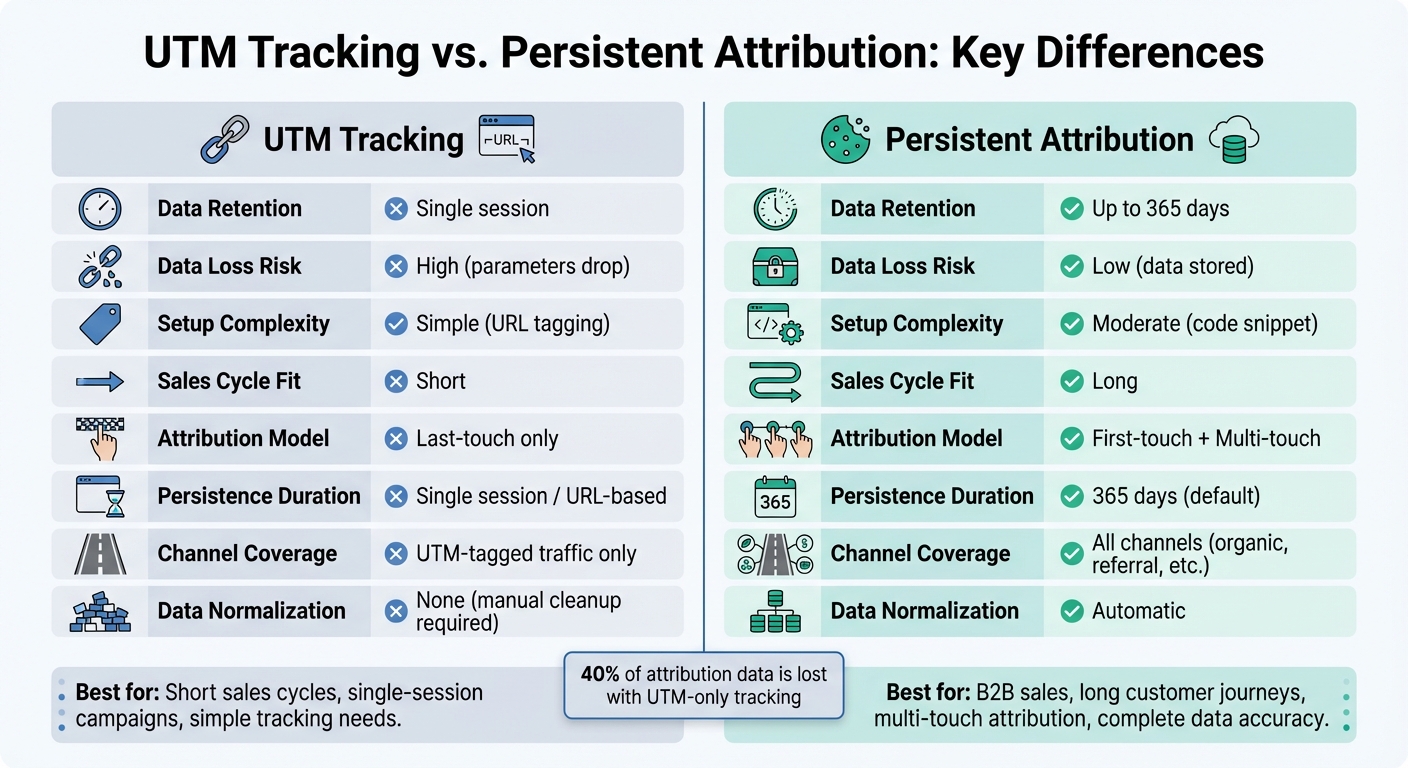
Here's a breakdown of the main differences between UTM tracking and persistent attribution. This table helps clarify the strengths and limitations of each method:
One standout difference is persistence duration. UTM tracking is limited to a single session, meaning it only captures source data for that specific visit. Persistent attribution, on the other hand, retains data for up to 365 days, making it far more reliable for tracking long-term customer journeys.
Implementation complexity is another key factor. While basic UTM tracking can be simple to set up with native tools, it doesn’t offer data persistence. Custom solutions built with Google Tag Manager (GTM) are more robust but require technical expertise and ongoing maintenance. Persistent attribution tools like Madlitics strike a balance - they only require a snippet of code and a few hidden form fields, eliminating the need for heavy development work.
When considering sales cycle suitability, the decision becomes clear. If your business operates on quick, single-session conversions, UTM tracking might suffice. But for B2B companies, SaaS platforms, or businesses with extended sales cycles, persistent attribution is critical. As Madlitics explains:
"If cookies expired too quickly, businesses would risk losing valuable attribution data for long sales cycles".
This comparison highlights the strengths of both methods, helping you decide which approach aligns with your business needs.
Deciding between UTM tracking and persistent attribution depends on three key factors: sales cycle length, campaign complexity, and your team's technical resources. Let's break it down.
UTM tracking works best for short sales cycles and straightforward conversion paths. Imagine a Black Friday email campaign where customers make purchases in a single session. In this case, simple URL parameters capture all the data you need. This method is perfect for e-commerce flash sales, direct-response ads, and other situations where conversions happen quickly.
On the other hand, persistent attribution is crucial for longer sales cycles that span multiple sessions. Take a B2B company with a 60-day sales cycle as an example. A prospect might click on a paid search ad (the first touch), later return via organic search, and finally fill out a form to convert. Without persistent attribution, the original UTM data gets lost after the first session, and the conversion might be misattributed as "Direct." This loss of data can lead to poor budget decisions, making persistent attribution a must for tracking these extended journeys.
Campaign complexity also influences your choice. For multi-channel campaigns - where users move from landing pages to blog posts and then to pricing pages before converting - persistent attribution ensures first-touch data is retained across visits. Tools like localStorage help maintain accurate source data, which is especially important in these more intricate conversion paths.
Finally, consider your technical resources. If you're a solo marketer or part of a small team without access to developers, UTM tracking's simplicity might be your best bet. However, if you have tools like Google Tag Manager or Madlitics, you can implement persistent attribution for a fraction of the cost of enterprise solutions. This approach delivers better data accuracy over time, ensuring your marketing efforts are tracked and optimized as you scale. The right choice here directly impacts the consistency of your data and the effectiveness of your budget decisions.

Madlitics' persistent attribution tackles some of the toughest attribution challenges, providing a solution that ensures consistent data and a clear marketing picture. Here's how it stands out:
Unlike standard UTM tracking, which only works when parameters are correctly applied, Madlitics ensures every inbound lead is categorized - even in the absence of UTM tags. Organic search, organic social, referrals, and direct traffic are all automatically tracked. Using signals like traffic type, referring domains, and known platforms, the system pinpoints each visitor's origin with precision. This eliminates the frustrating "Direct/None" data gaps that often occur with UTM-only setups.
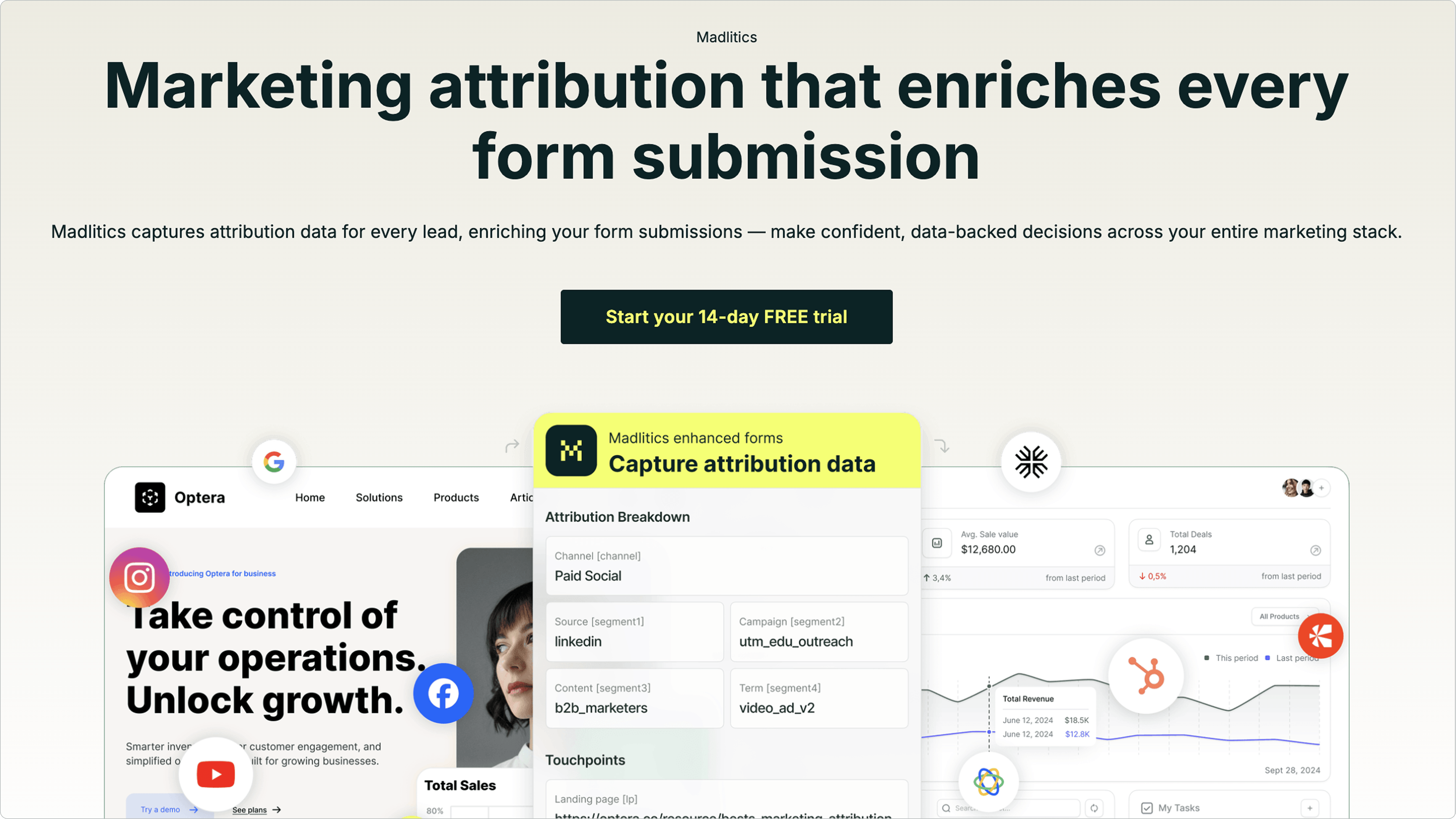
Madlitics stores the original source in a first-party cookie, and when a form is submitted, it injects attribution data into seven hidden fields: Channel, Segment 1 (Platform), Segment 2 (Campaign), Segment 3 (Term), Segment 4 (Content), Landing Page, and Landing Page Group. This ensures you get a complete view of your marketing efforts without any missing pieces.
Madlitics simplifies messy data by automatically normalizing variations, such as merging "Paid-Social" and "paid_social" into a single, consistent category. Sophie A., Head of Growth at a fintech company, shared her experience:
"We needed dependable channel categorization and UTM mapping without rewiring our stack. Madlitics delivered exactly that. It's now standard on every form we launch."
The platform doesn’t stop at cleaning channel data - it also retains landing page insights for every form submission. This means you can trace leads back to the exact pages and content that brought them in. Instead of just tracking traffic numbers, you’ll gain actionable insights into which content is driving conversions and revenue.
Madlitics integrates effortlessly into your existing workflow. All it takes is adding a code snippet and a few hidden form fields. It works seamlessly with major CRMs like Salesforce, HubSpot, Keap, and Zoho, as well as email platforms like Mailchimp, ActiveCampaign, and Klaviyo. Once set up, attribution data flows directly into the tools your team already uses.
Sam R., Growth Lead at a tech startup, highlighted this convenience:
"It's the first solution my team actually uses every day because the data shows up where they already work. No training, no new dashboards."
This streamlined integration helps drive higher conversion rates, reduce wasted ad spend, and directly connect campaign efforts to revenue. Plus, Madlitics offers a 14-day free trial - no credit card required - so you can see the benefits of marketing attribution firsthand.

https://yoursite.com/?utm_source=linkedin&utm_medium=paidsocial&utm_campaign=q1_promo

UTM tracking tends to lose its grip over time. Research shows that up to 40% of marketing attribution data disappears due to weak UTM persistence. When users move between pages or return days (or even weeks) later to convert, standard UTM parameters often vanish. This leaves you with "Direct/None" in your CRM, masking the true source of your leads and making it harder to allocate budgets wisely.
Persistent attribution, on the other hand, keeps first-touch data alive for up to 365 days using cookies. Whether your leads come from organic search, social media, or referral links, every form submission captures the full marketing journey. Plus, with automatic data cleaning, you eliminate issues like "Facebook" appearing multiple times under different spellings, giving you a clear and consistent view of your campaigns. This level of accuracy helps you focus on the channels that deliver the best results.
Madlitics makes persistent attribution easy. With just one code snippet and hidden form fields, you’ll get clean, organized data, complete channel tracking, and seamless CRM integration - no heavy development work required. The outcome? Better data, sharper insights, and confidence in where to invest your marketing dollars.
If you’re ready for attribution that actually works - showing you exactly where your best leads come from - try Madlitics free for 14 days. No credit card needed. Start seeing reliable results from day one.