Digital Marketing

5 Ways Marketing Attribution Improves Budget Allocation

Learn how accurate marketing attribution shows which channels actually drive revenue, cuts wasted spend, and turns budget planning into a predictable, data-backed process.
Attribution is broken

Marketing attribution helps you understand which marketing efforts lead to revenue, so you can make smarter, data-driven budget decisions. Without accurate attribution, up to 40% of your budget might be wasted on channels that don't work. Here's how attribution improves budget allocation:

  1. Identifies High-Performing Channels: Pinpoints which marketing channels drive revenue and conversions, avoiding guesswork.
  2. Enables Quick Budget Adjustments: Lets you reallocate funds to better-performing channels based on real-time data.
  3. Measures ROI Across Touchpoints: Tracks how every interaction contributes to revenue, giving you a full picture of performance.
  4. Reduces Spending on Non-Converting Channels: Exposes underperforming channels, so you can cut waste and focus on what works.
  5. Improves Future Budget Planning: Provides reliable data to predict which channels will deliver the best returns. Access our marketing attribution resources to streamline your data collection.

For example, MarketFlow, a SaaS company, discovered that Google Ads was overvalued under last-click attribution. By switching to a multi-touch model, they cut wasted ad spend and increased conversions by 23%, boosting revenue by $208,000 in three months.

Accurate attribution transforms budget planning into a predictable process, ensuring every dollar spent drives measurable results.


1. Shows Which Channels Deliver the Best Results

Channel Performance Insights

Attribution helps pinpoint which channels are driving leads and revenue. Without it, you're left guessing where to invest your budget and which channels might be wasting resources.

Some channels might generate a lot of traffic, but if they’re not converting, that traffic doesn’t mean much. Attribution connects the dots between initial touchpoints and closed deals, revealing which efforts are truly fueling growth.

Accuracy of Attribution Data

Inconsistent tracking - for example, labeling Facebook inconsistently - can create fragmented reports and make it harder to identify which channels are performing well.

Persistent attribution addresses this issue by tracking visitors across multiple sessions. This ensures that channels receive proper credit even when users take days to convert. It’s a game-changer for refining budget decisions since it ties every conversion back to the right source. Unlike session-based analytics that only reveal traffic trends, lead-level attribution connects directly to CRM data, providing a clearer picture of how marketing efforts translate into revenue.

This improved data accuracy lays the groundwork for better ROI analysis.

Impact on ROI Measurement

Multi-touch attribution uncovers the hidden value of top-funnel activities like content marketing and social media engagement - channels that last-click models often overlook. These awareness-driven efforts are frequently underfunded because they don’t get credit for the final conversion.

Here’s an example: A study of eight B2B SaaS companies found that multi-touch attribution showed content and SEO were undervalued by 19 percentage points, while Google Ads was overvalued by 26 percentage points under last-click attribution. That’s a huge misalignment that can lead to wasted resources and missed opportunities.

2. Allows Quick Budget Changes Based on Performance

Ability to Reduce Wasted Spend

Attribution gives you the power to shift budgets quickly based on performance data. High-performing marketing teams regularly adjust their spending - often weekly or monthly - to focus on channels that deliver results while cutting back on those that don’t. For instance, if a campaign isn’t converting clicks into actual bookings, funds can be redirected to higher-performing programs. Without this level of insight, budgets often get wasted on underperforming channels that generate activity but fail to drive meaningful conversions. With accurate data, you can make informed, real-time decisions to maximize your marketing dollars.

Accuracy of Attribution Data

Making quick budget adjustments relies on having clean, standardized data. Inconsistent naming conventions, like "Paid-Social" versus "paid_social", can create fragmented reports, slowing down decision-making. Standardization is key to ensuring that your data is reliable and actionable. Leading teams achieve attribution accuracy rates as high as 85% to 95%, while others struggle with rates as low as 30% to 40% - a gap that significantly impacts their ability to adapt and optimize effectively.

Support for Scaling and Forecasting

Attribution doesn’t just help with immediate adjustments - it also supports long-term planning. By ranking programs based on metrics like Return on Marketing Investment (ROMI), Customer Acquisition Cost (CAC), and payback periods, you can identify which channels offer the best opportunities for growth. This data also helps you avoid overinvesting in channels that have hit their saturation point, ensuring every dollar works harder for your business.

Tools like Madlitics integrate smoothly with your marketing stack, providing persistent attribution and automatically cleaned data. With these real-time insights, you can confidently make agile, data-driven budget decisions that fuel growth and efficiency.


3. Measures ROI Across All Marketing Touchpoints

Impact on ROI Measurement

Attribution digs deeper than basic metrics, uncovering which interactions truly drive revenue and close deals. By connecting every marketing interaction - whether it's a click, an email, or CRM data - to revenue outcomes, it reveals which touchpoints bring in high-value customers. This insight is invaluable for understanding the full impact of your marketing efforts.

Accuracy of Attribution Data

Measuring ROI accurately hinges on having clean, consistent data. Inconsistent naming or data discrepancies can distort your ROI picture. Top-performing marketing teams often achieve attribution accuracy rates between 85% and 95%, while others struggle with rates as low as 30% to 40%. To address this, data normalization plays a key role - it ensures that every dollar spent is correctly linked to the corresponding touchpoint. Tools like Madlitics streamline this process by automatically organizing and normalizing marketing data, making sure no touchpoint goes unrecorded.

With well-organized data, you can confidently assess the financial outcomes of each marketing channel.

Channel Performance Insights

Attribution provides the clarity needed to rank programs based on metrics like Return on Marketing Investment (ROMI), Customer Acquisition Cost (CAC), and payback periods. It allows you to calculate the marginal return for each channel. This level of detail not only shows which channels are converting but also highlights which ones deliver the best financial returns. With these insights, you can strategically allocate your budget to the channels that promise the highest impact.

4. Cuts Spending on Channels That Don't Convert

Highlighting Last-Click Bias

Last-click attribution can be deceptive, often giving too much credit to channels that aren't driving real value. Branded search and retargeting campaigns, for example, tend to look like top performers because they close the deal. But in reality, those conversions often stem from earlier touchpoints like content marketing or social media. This skewed view can lead to overfunding channels that simply capture demand, rather than creating it.

Take MarketFlow, a marketing analytics SaaS company, as an example. Back in September 2025, their last-click model suggested Google Ads was responsible for 44% of their conversions with a 2.1x ROAS. However, when CMO David Chen switched to a time-decay multi-touch attribution model, the picture changed dramatically. The updated data revealed that Google Ads' performance was overestimated by 26 percentage points. Its actual ROAS? A disappointing 0.95x - showing it was losing money. The channel was mostly benefiting from branded searches by users already influenced by SEO and content efforts.

"Last-click showed Google Ads delivering 47% of our pipeline... When we implemented multi-touch attribution, we discovered content/SEO was actually responsible for 64% of deals - Google Ads just got credit because people searched our brand name at the end." - David Chen, CMO, MarketFlow

Ability to Reduce Wasted Spend

Armed with these insights, MarketFlow slashed their Google Ads budget by 57%, dropping it from $28,000 to $12,000. The freed-up funds were reallocated to content creation and webinars. The results? Within just three months, total conversions jumped by 23%, and their marketing efficiency skyrocketed to a 3.1x ROAS, translating to an efficiency gain of $208,000 per month.

This kind of reallocation highlights the power of accurate data. Many companies unknowingly waste 25-40% of their marketing budgets due to poor attribution models. Clean, normalized data can expose underperforming channels before they drain resources. Tools like Madlitics simplify this process by organizing and normalizing marketing data, giving you a clear view of each channel's actual contribution. With reliable data, it's easier to spot which channels are wasting money and cut them before they hurt your bottom line.

5. Helps Plan Future Budgets with Reliable Data

Support for Scaling and Forecasting

Reliable attribution data transforms future budget planning from guesswork into a strategic process. Instead of reacting to past results, teams can use historical data to predict which initiatives are likely to drive growth. This approach helps pinpoint which channels can handle additional investment without diminishing returns and which ones may have already hit their limits.

For example, a SaaS team applied W-shaped attribution and search holdout tests to uncover budget misallocations. By redirecting 16% of their spend, they achieved a 31% improvement in ROMI and shortened their payback period by 2.5 months.

Accuracy of Attribution Data

Forecasting accuracy hinges on clean, consistent data. Small inconsistencies - like using "Paid-Social" in one campaign and "paid_social" in another - can fragment data and disrupt forecasts. Clean, normalized data ensures that forecasts are both reliable and actionable.

"Attribution informs budget by quantifying marginal return for each channel, offer, and audience." – The Pedowitz Group

Madlitics simplifies this process by automatically organizing and normalizing marketing data. Every form submission is enriched with precise channel and campaign details, allowing teams to rank programs by metrics like marginal ROMI and CAC. This clarity enables confident budget allocation to the channels delivering the best returns.

Channel Performance Insights

A clear understanding of channel saturation is essential for accurate budget planning. Saturation curves - indicating the point where additional spending no longer yields efficient returns - are crucial for identifying when to scale back or reallocate resources. Attribution data helps teams recognize when a channel reaches its capacity, avoiding wasteful over-investment.

Additionally, reconciling marketing spend with actual bookings and revenue on a monthly basis ensures that budget adjustments are grounded in tangible financial results rather than abstract metrics. This method ensures that future budgets are built on solid data, driving growth while minimizing inefficiencies.

Madlitics multi-channel attribution visualization, showing marketing platforms like TikTok, Instagram, Google, and Facebook. The graphic highlights how different sources contribute to high-performing marketing channels.
1. Add UTM parameters to all inbound links
Any marketing effort that drives traffic — whether it’s a paid ad, an email campaign, or an organic post — should have properly structured URLs that clearly define the visitor’s origin. Setting it up is a straightforward process that starts with ensuring all inbound links include UTM parameters.

A LinkedIn campaign, for example, might link to:
https://yoursite.com/?utm_source=linkedin&utm_medium=paidsocial&utm_campaign=q1_promo
Screenshot of a form builder interface with a highlighted 'Hidden Input' field. Accompanied by text explaining how to install and set up Madlitics by adding hidden fields to capture marketing attribution data.
2. Add hidden fields
Once you’ve added UTM tracking to your inbound links, the next step is to install Madlitics on your site and update your Framer Forms to include hidden fields that will store attribution data when a visitor submits a form automatically. Hidden fields to include:
• Channel (e.g., Paid Search, Organic Social, Direct)
• Segment 1 (Platform name: Google, LinkedIn, Twitter)
• Segment 2 (Campaign name)
• Segment 3 (Ad group, offer name, or post type)
• Segment 4 (Creative type or ad variation)
• Landing page/group (Tracking & first-touch attribution)
CRM interface showing a detailed view of captured attribution data, including marketing channels, segments, and landing pages. A business profile of a lead is displayed, highlighting how Madlitics enriches lead data for sales and marketing teams.
3. Utilize attribution data
With the setup complete, every form submission in Framer now carries full attribution data, ensuring accurate insights into where leads originate. Pass this data to your CRM, analytics tools, or marketing automation platforms to track performance, refine campaigns, and optimize marketing efforts with precision.

Marketing attribution transforms guesswork into precise, data-driven strategies. Instead of relying on surface-level metrics or evenly splitting budgets across channels, teams can focus on programs ranked by metrics like marginal return, CAC, and payback. This allows marketers to channel their resources into initiatives that deliver the most impact for the cost. The difference is clear: top-performing marketing teams achieve 85–95% attribution accuracy, while average teams often operate with only 30–40% accuracy. Poor attribution systems can misdirect 25–40% of marketing budgets, leaving a significant portion of potential revenue untapped.

"Attribution accuracy isn't optional; it's the frontline defense for your marketing budget." – Ashleigh McCabe, Hurree

Shifting from reactive marketing to informed decision-making hinges on clean, consistent attribution data that links marketing efforts directly to revenue. This ensures every conversion is accurately traced back to its source, enabling smarter, data-backed strategies.

For teams looking to address these challenges, a reliable solution is crucial. Madlitics makes it easy. By enriching every form submission with detailed attribution data - including channel, platform, campaign, and landing page information - teams can quickly identify where their best leads are coming from. The platform integrates seamlessly, offering actionable reports that link marketing spend to closed deals. It also resolves data inconsistencies (like standardizing variations of "Paid-Social"), ensures attribution persists across sessions, and tracks all traffic sources - not just paid campaigns. This comprehensive approach gives teams the clarity they need to focus their budgets on what works.

With a 14‑day Madlitics free trial, teams can immediately start pinpointing which channels drive growth and where to invest further - without needing to overhaul their systems. These strategies highlight how accurate attribution can revolutionize budget planning and marketing performance.

Related articles to get you started with Madlitics

Frequently asked questions

Answers to your top questions about our UTM parameters
Put attribution data to work
Sync, analyze, and automate — turn insights into action.
Automation icon indicating hands-free marketing attribution and data flow.
Sync with your CRM
Pass UTM parameters into Salesforce, HubSpot, or ActiveCampaign so your sales team knows exactly where every lead came from — no more guessing.
Analytics report icon, indicating data insights and reporting.
Built smarter reports
Use Google Sheets, Looker Studio, or Airtable to create data-driven reports that reveal which campaigns drive real revenue — helping you make informed budget decisions.
Impact measurement icon, symbolizing marketing effectiveness.
Track revenue impact
Sync UTM data with Stripe, PayPal, or Chargebee to see which campaigns generate paying customers, not just leads — so you can scale what works.
Personalization icon, representing customization features.
Personalize email campaigns
Trigger personalized email flows in Klaviyo, Mailchimp, or ConvertKit based on a lead’s original source — ensuring the right message reaches the right audience.
Visualizing your marketing impact
See how attribution data translates into actionable insights.
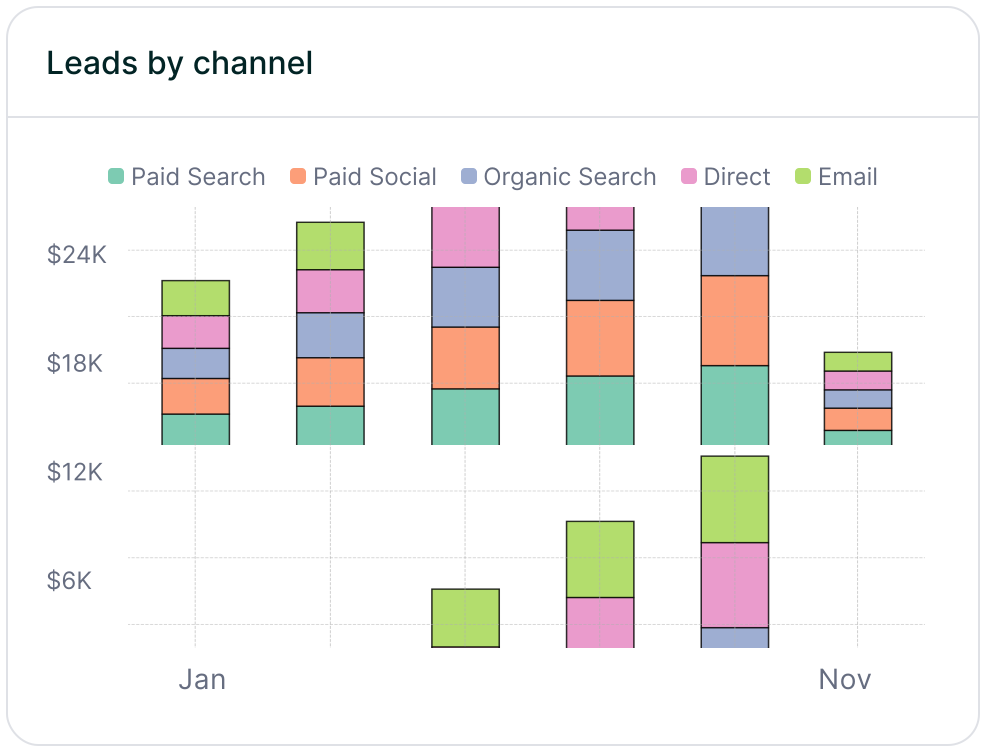
Stacked bar chart showing lead generation by marketing channel over time, comparing sources like Paid Search, Paid Social, Organic Search, Direct, and Email. Helps visualize which channels drive the most traffic.
Leads by channel
See how different marketing channels contribute to lead generation over time. Understand which ones drive the most traffic and whether your marketing mix is balanced. Shift your budget toward the highest-performing channels to maximize results.
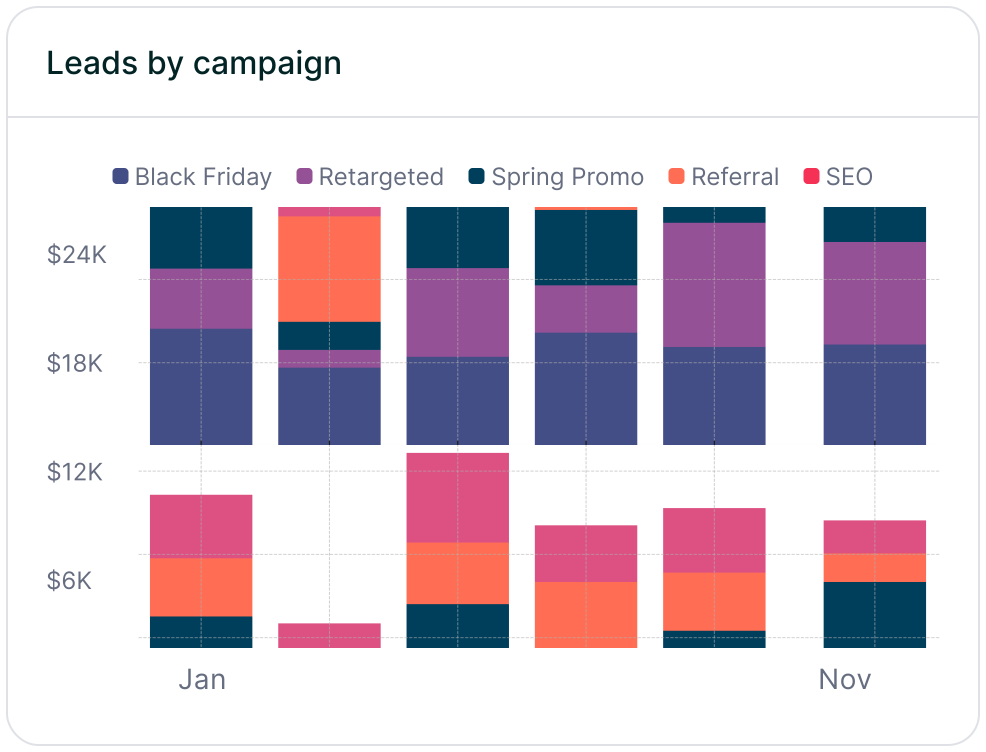
Stacked bar chart illustrating lead volume across different marketing campaigns, including Black Friday, Retargeted, Spring Promo, Referral, and SEO. Highlights trends in campaign effectiveness.
Leads by campaign
Track inbound leads across all campaigns, whether or not they have UTM parameters. Ensure every lead is categorized correctly, including Organic and Referral traffic. Use this insight to refine messaging, targeting, and budget allocation for better performance.
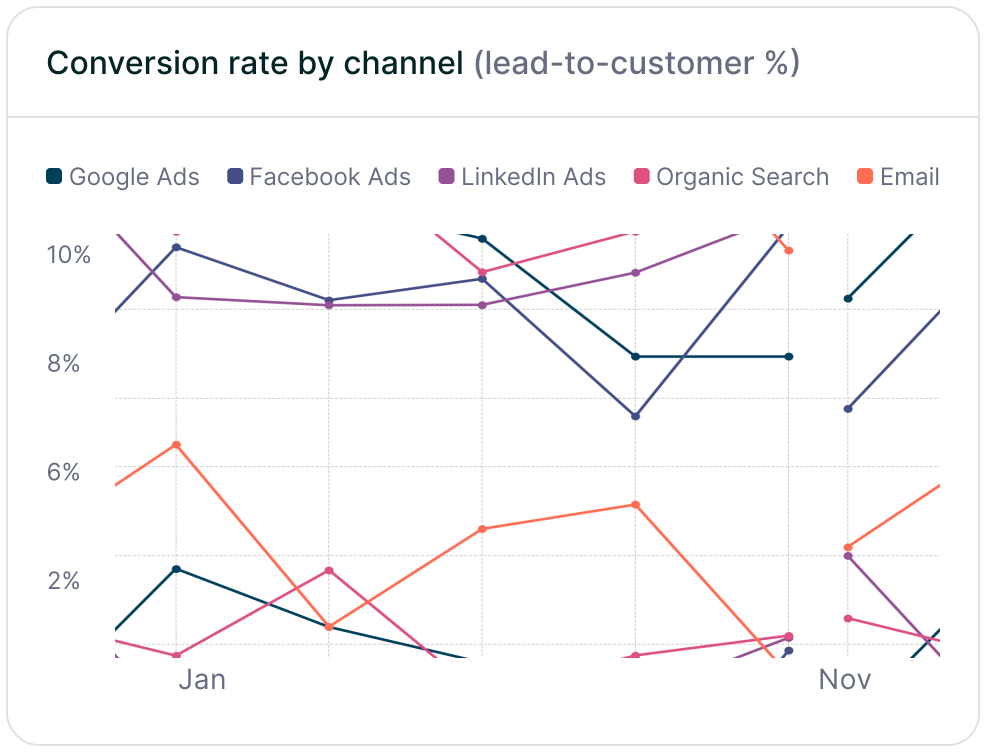
Line chart displaying lead-to-customer conversion rates by channel, comparing Google Ads, Facebook Ads, LinkedIn Ads, Organic Search, and Email. Shows how different sources drive qualified leads over time.
Conversion rate by channel
See which channels convert leads into paying customers. Some bring buyers, while others generate unqualified leads. Focus your budget on what drives revenue.
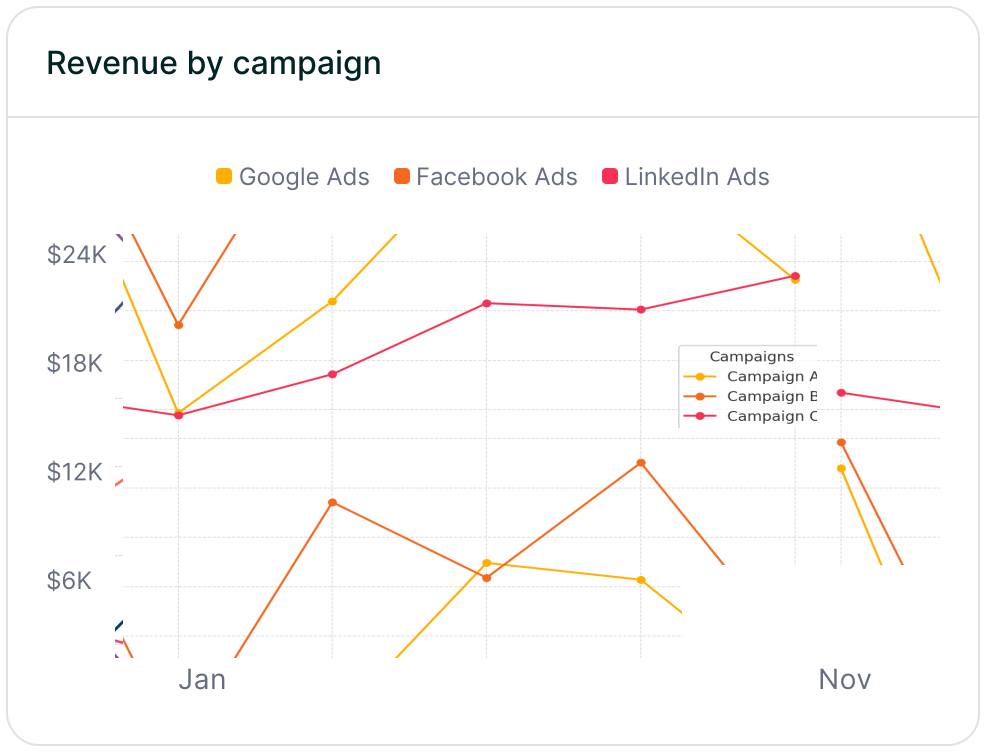
Line chart showing revenue performance by marketing campaign, comparing Google Ads, Facebook Ads, and LinkedIn Ads. Helps identify top-performing and underperforming campaigns.
Revenue by campaign
Focus your budget on campaigns that drive revenue, not just leads. Identify top performers and optimize underperforming efforts to maximize profitability.
Everything you need for reliable lead attribution
Accurate, persistent, and automated tracking — so your campaigns perform at their best.
Performance icon symbolizing marketing campaign effectiveness and results tracking.
Outperforms basic UTM tracking
Madlitics captures, categorizes, and persists attribution data across sessions, giving you a complete, structured view of what’s working in your marketing. Say goodbye to losing attribution when users navigate your site, struggling with formatting inconsistencies, and ingored non-UTM traffic.
Capture icon indicating data collection from various marketing channels and sources.
Capture all traffic
Madlitics categorizes all inbound leads — whether they have UTM parameters or not — so every conversion is accounted for, and you won't miss out on Organic Search, Organic Social, and Referral traffic.
Routing icon representing the flow of marketing data and attribution pathways.
Attribution across pages and sessions
A LinkedIn ad click should be attributed correctly—even if the visitor signs up on a different page later. If someone clicks an ad, browses multiple pages, then submits a form later, Madlitics persists attribution data across sessions, ensuring your reports reflect true performance.
List icon representing structured marketing data, reports, or campaign breakdowns.
Cleaner, more reliable data
Duplicate UTMs and inconsistent formatting break reports and mislead teams. Madlitics cleans and organizes attribution data before sending it to your CRM, giving you accurate insights.
Target icon symbolizing precise audience targeting and marketing campaign focus
See which content converts
Attribution isn’t just about where visitors came from—it’s about what convinced them to convert. By capturing landing page data alongside UTM parameters, Madlitics shows you which blog posts, case studies, or pricing pages drive the most revenue, helping you scale content that works.
Action icon representing campaign execution, optimization, and engagement.
Transform form submissions into actionable insights
Madlitics connects marketing touchpoints to lead generation, ensuring every form submission is fully attributed — optimize ad spend by identifying high-ROI channels, refine messaging based on what content drives engagement, make data-driven decisions with clean, structured reports, and more.